
Four criteria that determine whether distributed storage holds up in a low-voltage network that is no longer balanced.
The low-voltage network is no longer balanced, and it is not returning to a balanced state. Single-phase rooftop solar, single-phase EV charging and uneven load growth mean that voltage imbalance across the three phases is now the normal operating condition on most feeders.
This has a consequence for distributed storage that is often overlooked in procurement. The reliability of a distributed battery is not only a question of cell chemistry or warranty terms. It is a question of whether the asset keeps delivering in the network as it actually is, whether it avoids the failure modes that take enclosed batteries offline, whether it can be restored quickly when it needs service, and whether the operator retains control of it once it is connected.
Those four criteria are where a specification for distributed storage should focus.
Correcting the network the asset operates in
Modern networks are being driven towards unbalance. The prevalence of high power single phase generation and loads – such as PV or EV charging – introduce unbalance that interferes with 3 phase inverters that lack STATCOM capabilities.
In an unbalanced feeder, the modern utility grade BESS with STATCOM capabilities regulate each phase independently, absorbing or injecting reactive current per phase to bring phase voltages back within limits, and it maintains that correction continuously while it charges or discharges real power. It creates its own voltage headroom, then uses it.
A conventional three-phase BESS injects balanced current across all three phases. Where the feeder is already unbalanced, or sitting near a per-phase voltage limit, that inverter has little room to deliver its rated real power. It curtails, or it trips. The more single-phase DER and EV charging on the feeder, the more often this occurs.
As imbalance becomes the standard condition, an asset that corrects the condition it operates in is materially more resilient than one that depends on the condition being favourable. The specification point is independent per-phase real and reactive control, maintained continuously during charge and discharge.
Operating without air conditioning
This removes one of the most common failure and maintenance points in enclosed battery systems. Air-conditioning is an active mechanical system with its own compressors, fans and refrigerant circuit. When it fails, the battery it protects is exposed, and it is a recurring service item over the life of the asset.
It also removes the parasitic load that air-conditioning draws continuously, which improves round-trip efficiency: less of the stored energy is lost to running the enclosure. It lowers the acoustic footprint of the asset, verified by type testing, which matters wherever storage is sited near residential or community areas.
The specification points are an auxiliary-load ceiling, an acoustic limit expressed in dB(A) at a stated distance, and no active mechanical cooling as a single point of failure. Passive cooling meets these on engineering merit.
Modular service by unit swap
Modern distributed storage keeps the inverter/STATCOM and the battery enclosure as separate modules. Damage or a scheduled service event in one module is contained to that unit; the other is unaffected.
For the operator, this changes the maintenance model. Field service becomes a module swap against a spare, rather than an on-site repair. The site is returned to service in a short, planned window, and the damaged module is repaired off-site. Spares can be pooled across a fleet, so the effective mean time to restore is the time to swap a unit rather than the time to diagnose and rebuild one in the field.
Uptime therefore becomes a property of the deployment model, not only of the hardware. The specification point is independent replaceability of the power conversion and storage modules without decommissioning the other.
Operator control of the asset
Cybersecurity compliance is paramount, and legacy BESS that require a manufacturer connection or phone home introduce cybersecurity risks. Modern BESS communicate over, widely supported protocols: DNP3 and Modbus, fully controlled by the operating utility. There should be no mandatory link back to the manufacturer, and the asset does not require any connection to the vendor to operate.
This means the network operator owns the control, software and firmware lifecycle. The asset is held to the operator’s own compliance and security posture, and kept within network compliance conditions by the operator. Remote support from EcoJoule is available if the operator wants it, but it is optional, not built into how the system runs.
There are power conversion systems manufactured in Australia. For operators applying trusted-origin or sovereign-supply criteria to grid-connected devices, an increasingly common part of procurement, that origin is a material point.
The specification points are open protocol support, no mandatory vendor communications, operator ownership of the firmware lifecycle, and trusted origin of the power conversion equipment.
What this means for planners
A reliable distributed battery is one that keeps delivering in an unbalanced network, avoids the failure modes that take enclosed batteries offline, can be restored inside a short planned window, and stays under the operator’s control. None of these is decided after installation. They are architectural choices — a per-phase STATCOM front end, passive cooling with no active HVAC to fail, separable modules, and open protocols with no vendor dependency — made in the design of the asset.
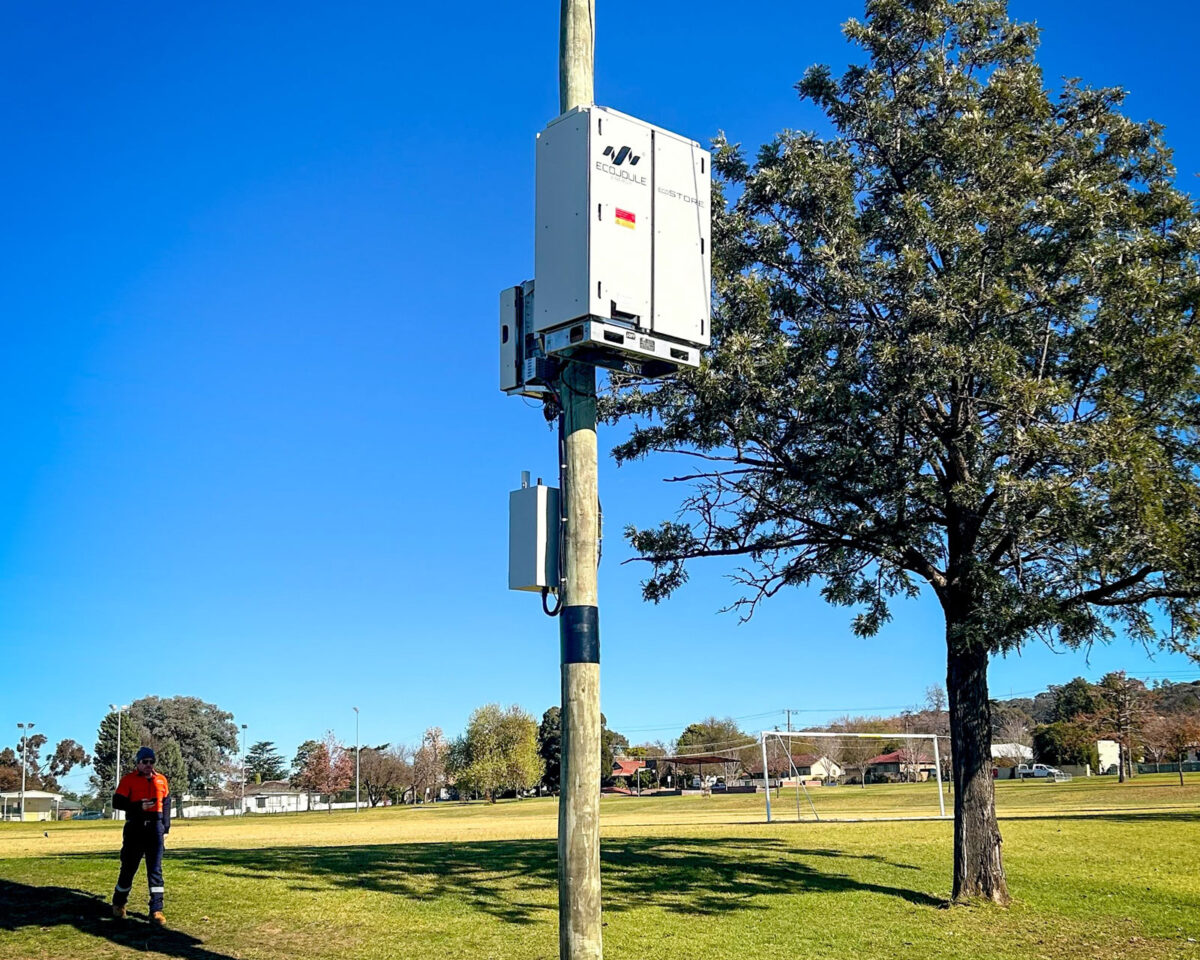
These key design choices are integrated in the EcoJoule EcoSTORE pole mount BESS.
Specified as outcomes rather than mechanisms, these four criteria give a procurement team a defensible basis for selecting distributed storage that will hold up in the network as it actually operates.