
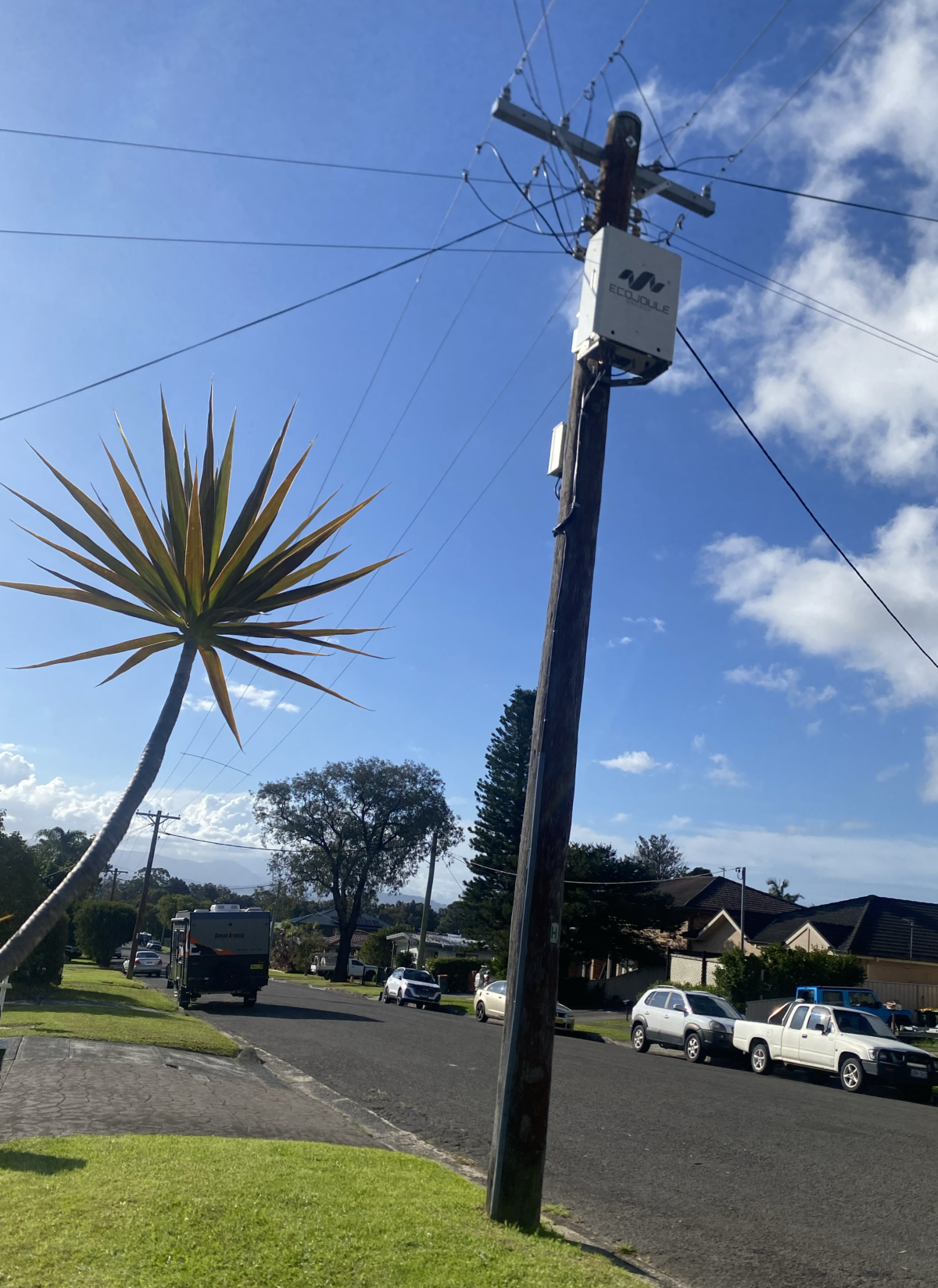
Why a 40 kVAr device supports voltage on a feeder carrying far more than 40 kVA, and how much correction to expect
A common question from distribution engineers assessing a low voltage D-STATCOM is how a 40 kVAr device can support voltage on a feeder that carries far more than 40 kVA. The question almost always traces to one assumption: that the device sits in series with the feeder and must carry the full load current, the way a line voltage regulator does.
A shunt-connected D-STATCOM does not work that way. It connects in parallel, carries only its own reactive current, and supports voltage through the reactance between its connection point and the source. This note sets out the mechanism and works a representative example.
Series and shunt connection are different problems
A series voltage regulator is installed in line with the feeder. All feeder current passes through it, so it must be rated for the full through-current, often several hundred amps. Measured against that benchmark, 40 kVAr looks too small to matter.
A shunt D-STATCOM connects across the feeder at a single point. Feeder current does not pass through it. The device carries only the current corresponding to its own rating:
I = Q / (√3 × V) = 40,000 / (√3 × 400) ≈ 58 A
where Q = 40 kVAr, V = 400 V phase to phase
That 58 A is independent of feeder loading. The device is sized to its own reactive current, not to the feeder it supports.
How reactive injection raises voltage
The network behind any connection point can be represented as a source with a series impedance, R + jX, back to it. Current flowing through that impedance produces a voltage difference. The familiar low voltage drop relationship is:
ΔV ≈ (P·R + Q·X) / V
A shunt D-STATCOM supplies reactive power locally, so that reactive power no longer has to be imported through the upstream reactance X. Removing Q from the upstream path removes the Q·X voltage drop it was causing, and the local voltage rises. For a reactive-only device the support reduces to:
ΔV ≈ Q·X / V
Worked example
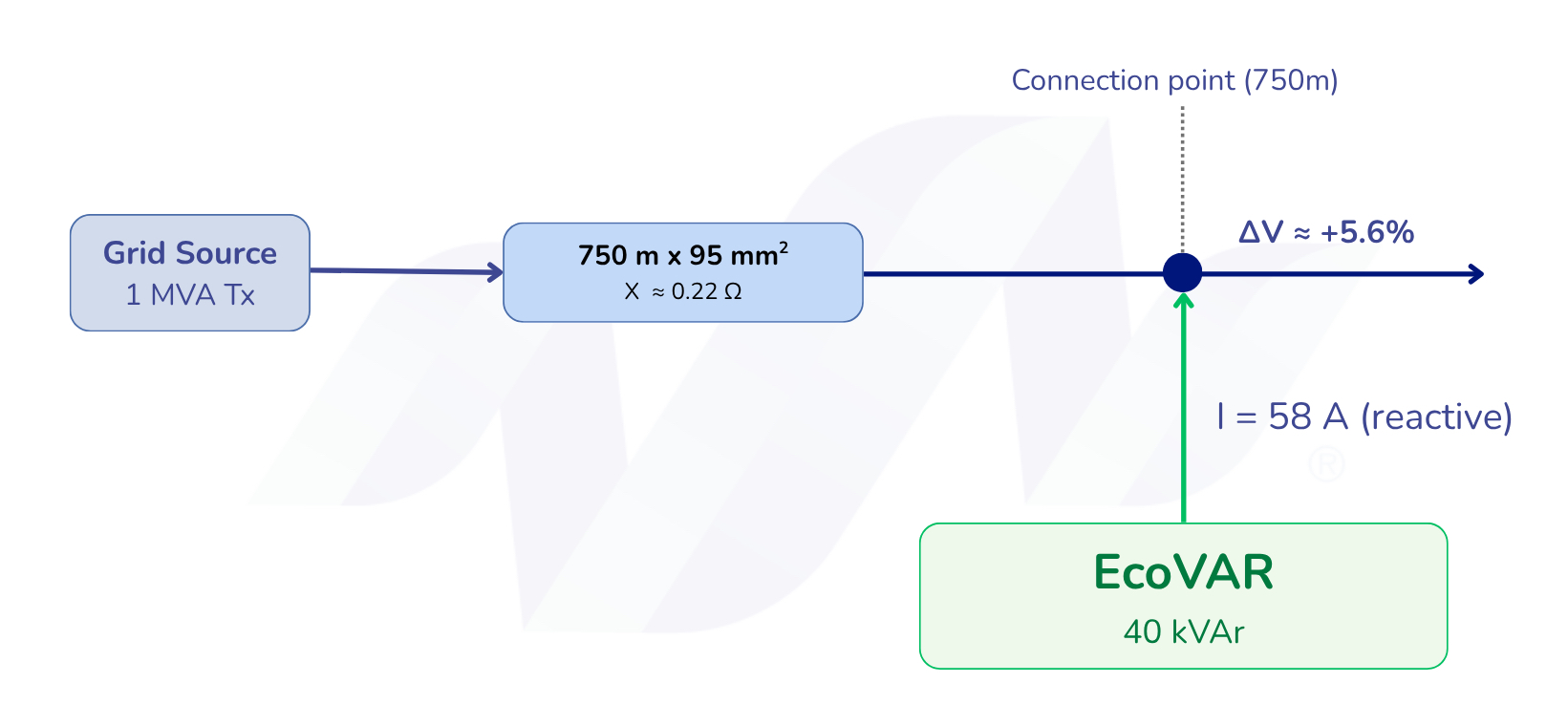
Consider a 1 MVA distribution transformer feeding a 1 km low voltage feeder on 95 mm² overhead conductor, with the D-STATCOM connected 750 m along the feeder. Representative values:
| Transformer reactance | Xtx ≈ 0.008 Ω |
| Line reactance to the connection point (0.29 Ω/km × 0.75 km) | ≈ 0.218 Ω |
| Total upstream reactance | X ≈ 0.225 Ω |
Applying the relationship:
ΔV ≈ Q·X / V = 40,000 × 0.225 / 400 ≈ 22.5 V ≈ 5.6%
The same result follows from the device current and the upstream reactance, which is worth showing because the two routes are the same physics:
ΔVLL ≈ √3 × I × X = √3 × 58 × 0.225 ≈ 22.5 V
On this feeder, a 40 kVAr device applies about 5.6% voltage correction at its connection point.
It’s important to remember that the STATCOM can both source and sink VARs, so it can move the voltage in either direction, either up or down 22.5V in this simplified case. This allows it to respond to voltage rise from solar, or voltage drop from load, in real time.
The connection point sets the result
The feeder in the example is 1 km long, but the device sits at 750 m. The final 250 m plays no part in the calculation, because the device’s reactive current flows back to the source through the upstream reactance only. Voltage authority is set by the impedance between the device and the source, not by the total feeder length. This is why siting matters: the device belongs where the upstream reactance, and the voltage problem, are greatest. It is also the clearest distinction from a series device, whose effect depends on what lies downstream of it.
Where the relationship applies
The Q·X / V relationship depends on the feeder having meaningful reactance. Overhead open-wire conductor, with an X/R ratio near 1, meets that condition. On low-reactance cable the same kVAr produces little voltage movement, and a D-STATCOM earns its place through phase balancing rather than bulk reactive support.
It is also worth separating the correction the device applies from the total feeder voltage drop. On a feeder with X/R near 1, the real-power drop (P·R) from load current is comparable to the reactive drop, and a reactive device does not act on it. The 5.6% figure is the correction available at the connection point, not the elimination of the feeder’s full drop under load.
In practice. A shunt D-STATCOM provides voltage correction at the point where it is needed, sized to its own reactive current rather than to feeder loading. The EcoVAR adds two capabilities relevant to low voltage feeders: independent phase balancing, which addresses the per-phase voltage problem that symmetric reactive injection cannot, and installation without a feeder outage. On a weak overhead feeder these allow voltage to be corrected at the connection point in place of, or ahead of, conductor augmentation.