
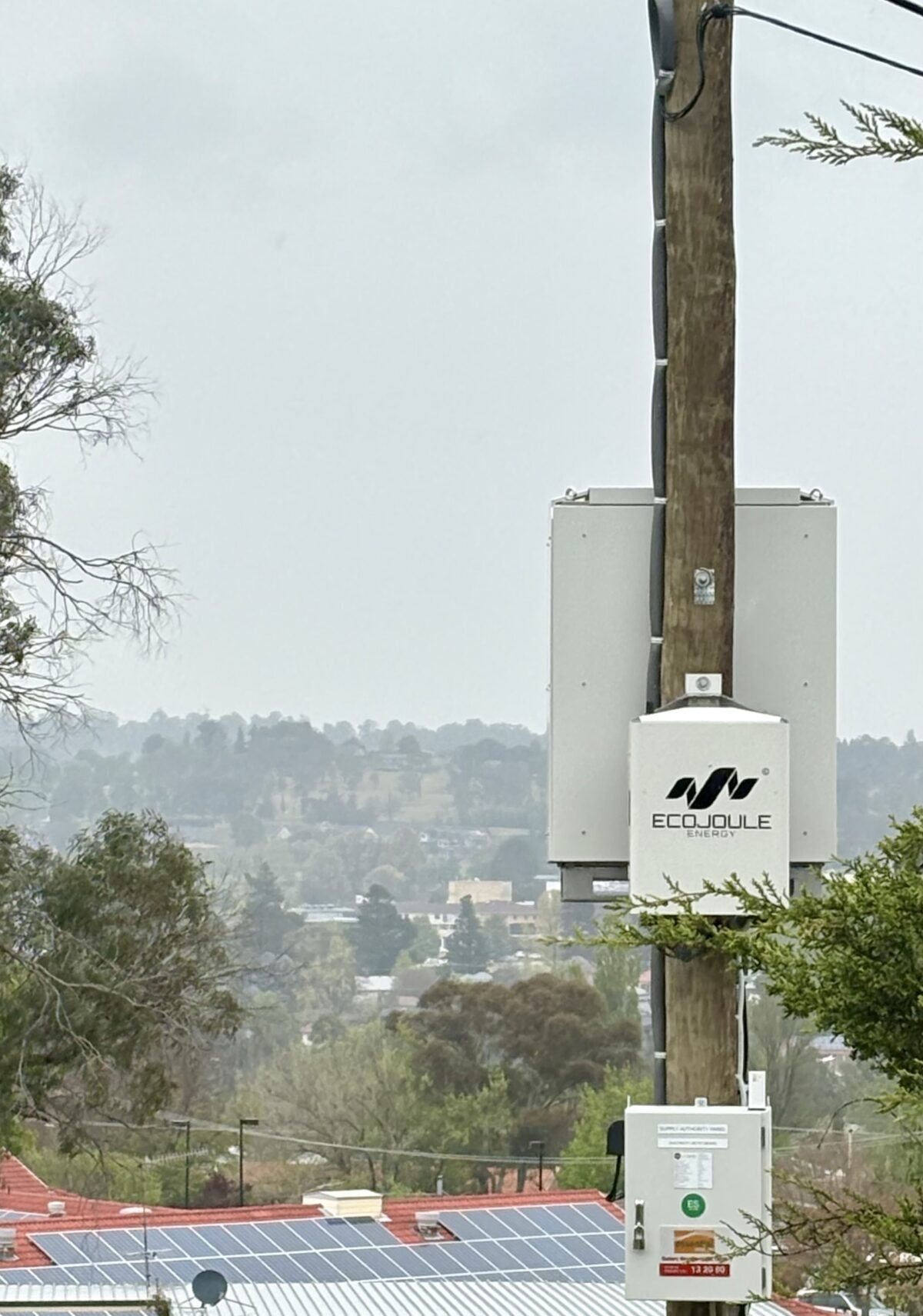
EcoJoule Energy’s EcoVAR Low Voltage D-STATCOM delivers utility-scale power quality outcomes from distributed installations — addressing voltage instability, phase imbalance, and harmonics at the point of cause, rather than attempting centralised correction downstream.
A common assumption in network planning is that system-scale problems require system-scale equipment. EcoJoule Energy’s EcoVAR challenges that assumption — and the evidence from operating deployments supports a different conclusion: distributed power quality correction, applied at the source of grid stress, is more effective, more cost-efficient, and more resilient than centralised approaches.
The EcoVAR is a Low Voltage Distribution STATCOM (D-STATCOM) installed on the LV distribution network by the utility. A single unit serves all customers downstream on a feeder segment, from typically 5 to 200 residential connections, or a combination of residential and commercial loads including three-phase commercial buildings.
The device is not a customer-premises solution. It is utility infrastructure, approved, owned, and operated by the network business.
The Case for Distributed Correction
Distribution networks are not uniform. Voltage instability, phase imbalance, and harmonic distortion each originate at specific points on the network. They are at the customer connection, at the inverter, at the motor load. Centralised solutions, whether at the substation or at transmission level, address these problems after the fact, working against the impedance of the network itself.
The physics favour distribution. Reactive power, which governs voltage stability, cannot be efficiently transported over long distances. Every kilovar of reactive support sourced locally avoids the losses associated with delivering that support from a remote point. An EcoVAR installed at the end of a feeder provides reactive compensation where the voltage drop is greatest, with no transmission losses and no dependency on upstream infrastructure capacity.
“Centralised solutions address power quality problems after they have already propagated through the network. The EcoVAR eliminates them at the point of origin, which is where they do the most damage.”
Dr Mike Wishart, CEO EcoJoule Energy
The same principle applies to harmonics. Distortion generated by inverter-based loads, variable speed drives, and EV chargers propagates upstream through the network. Filtering that distortion at or near the source, before it reaches the substation transformer, reduces impedance stress throughout the network. Centralised harmonic management addresses the symptom; distributed filtering addresses the cause.
Stacked Economic Benefits: How Utilities Build the Business Case
The EcoVAR’s value is not derived from a single performance metric. Its business case is built by stacking measurable outcomes across the performance categories that regulators and utilities already track: voltage compliance, loss reduction, asset life, and capital deferral. Each benefit is independently quantifiable; together they produce a compelling investment case even at the individual feeder level.
Voltage Regulation Compliance
The EcoVAR provides continuous dynamic VAr compensation, maintaining voltage within statutory limits in real time. For feeders where voltage regulators are cycling rapidly due to embedded generation or variable loads, the EcoVAR reduces the regulation burden and measurably extends voltage regulator asset life. This is a directly quantifiable O&M saving.
Phase Imbalance and Neutral Loss Reduction
Single-phase residential loads create phase imbalance that causes neutral current, increased distribution losses, and thermal stress on LV transformers. The EcoVAR dynamically balances phases in real time, reducing losses and extending transformer service life. Distribution loss reduction is a directly reportable metric with measurable dollar value per MWh recovered.
Active Harmonic Filtering — Network-Wide
The EcoVAR includes active harmonic filtering, addressing IEEE 519 and equivalent harmonic compliance obligations at the feeder level. Rather than requiring individual commercial customers to install dedicated filter banks, a single EcoVAR manages harmonic distortion for all connected loads, all reducing administrative burden and providing more consistent network-wide compliance.
Three-Phase Commercial Load Quality
For feeders serving commercial and industrial customers with three-phase supply, voltage imbalance causes motor derating, increased copper losses, and equipment failure. The EcoVAR corrects three-phase voltage imbalance in real time, reducing customer complaints, improving reliability metrics, and extending the service life of customer and network equipment alike.
DER Integration and Capital Deferral
As rooftop solar penetration increases, overvoltage from reverse power flow becomes a feeder-level constraint that would otherwise require reconductoring or substation upgrades. The EcoVAR manages this dynamically, deferring or eliminating network augmentation expenditure. Avoided capital is the highest-value economic argument in a utility rate case or regulatory investment proposal.
Scale Through Distribution: Many Units, One Outcome
The objection that distributed solutions cannot achieve system scale impacts misunderstands how distribution networks function, they are in fact distributed systems themselves. It makes intuitive sense that a distributed solution is the best solution for distribution networks. A utility deploying EcoVARs across a portfolio of feeders achieves network-wide power quality improvement through coordinated distributed correction. This is the same principle that underpins modern distributed energy resource management. The EcoVAR is not a substitute for system planning; it is a tool that makes existing infrastructure more capable, deferring the need for system-level intervention.
KEY INSTALLATION ADVANTAGE
The EcoVAR requires no network outage for installation. It connects to existing LV infrastructure and eliminates the switching costs and customer disruption associated with alternative network upgrades. This reduces the total cost of deployment and simplifies scheduling for network operators.
Critically, each EcoVAR installation is independently valuable. The business case does not depend on network-wide deployment. A single unit on a constrained feeder delivers measurable, reportable outcomes from day one. Voltage compliance, loss reduction, asset life extension, all while the utility builds confidence in the technology before broader rollout.
This deployment model reduces investment risk significantly compared to large, centralised infrastructure projects, which require full commitment before any benefit is realised.
About EcoJoule Energy
EcoJoule Energy designs and manufactures Low Voltage Distribution STATCOMs (EcoVAR) and Battery Energy Storage Systems (EcoSTORE) for electricity distribution networks worldwide. EcoJoule’s technology is deployed by utilities across Australia, Asia-Pacific, and Europe. The company’s mission is to ensure that the benefits of the energy transition reach all users of the distribution grid — by relieving grid congestion, enabling solar generation to reach more customers, and maximising the capacity of existing network infrastructure. EcoJoule is headquartered in Brisbane, Australia.
MEDIA ENQUIRIES
Martin van der Linde
Chief Commercial Officer
sales@ecojoule.com