As distributed solar generation and EV charging reshape load profiles hour by hour, static compensation and scheduled phase balancing can no longer keep pace. EcoJoule’s EcoVAR addresses the root cause: dynamically, continuously, and without taking feeders out of service.
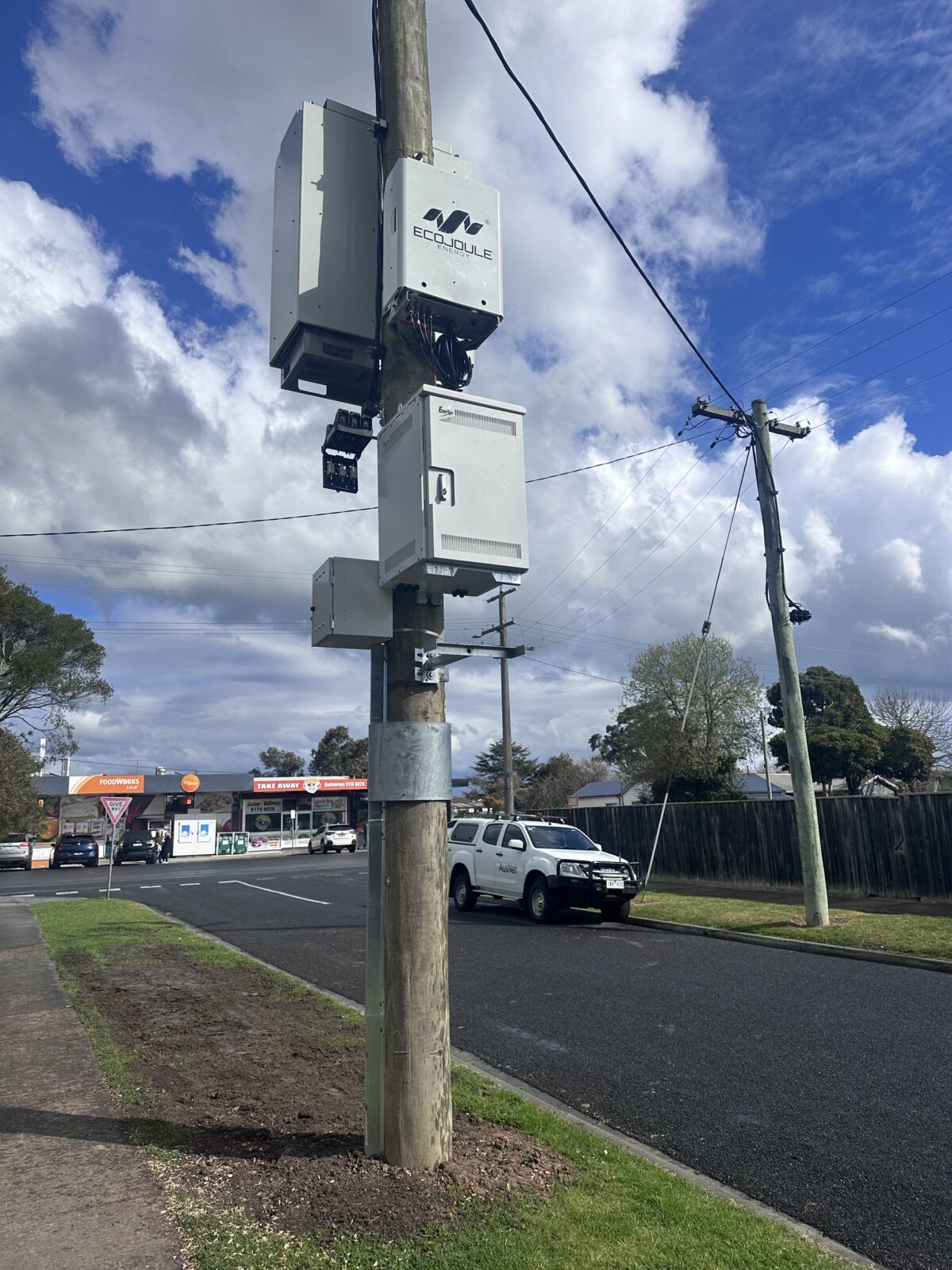
Distribution engineers across four continents are specifying EcoJoule’s EcoVAR low voltage D-STATCOM as the primary tool for managing congestion, voltage instability, phase imbalance, and harmonic pollution on LV networks. The EcoVAR is pole-mounted on existing overhead LV infrastructure. In form and installation footprint it closely resembles a conventional MV/LV distribution transformer, connected directly to each LV phase conductor. Four technical characteristics consistently drive specification decisions.
1. Maximise existing infrastructure: defer or eliminate capital augmentation
Traditional network congestion has a traditional answer: build more poles and wires. Overhead line augmentation typically costs an average of $560,954 per km, with some DNSP’s reporting over $1.5M AUD per km in submissions to the energy regulator. LV augmentation often requires easements, community consultation, and civil works measured in years, and delivers capacity that may be underutilised for the first decade of operation.
A single EcoVAR unit provides reactive power compensation, voltage regulation, and harmonic filtering from an existing pole position on the LV overhead network. By correcting power factor and reducing resistive losses in real time, it recovers usable capacity on conductors already in service. In documented deployments, a single installation has deferred line augmentation by three to seven years, with capital savings representing a substantial multiple of the device and installation cost.
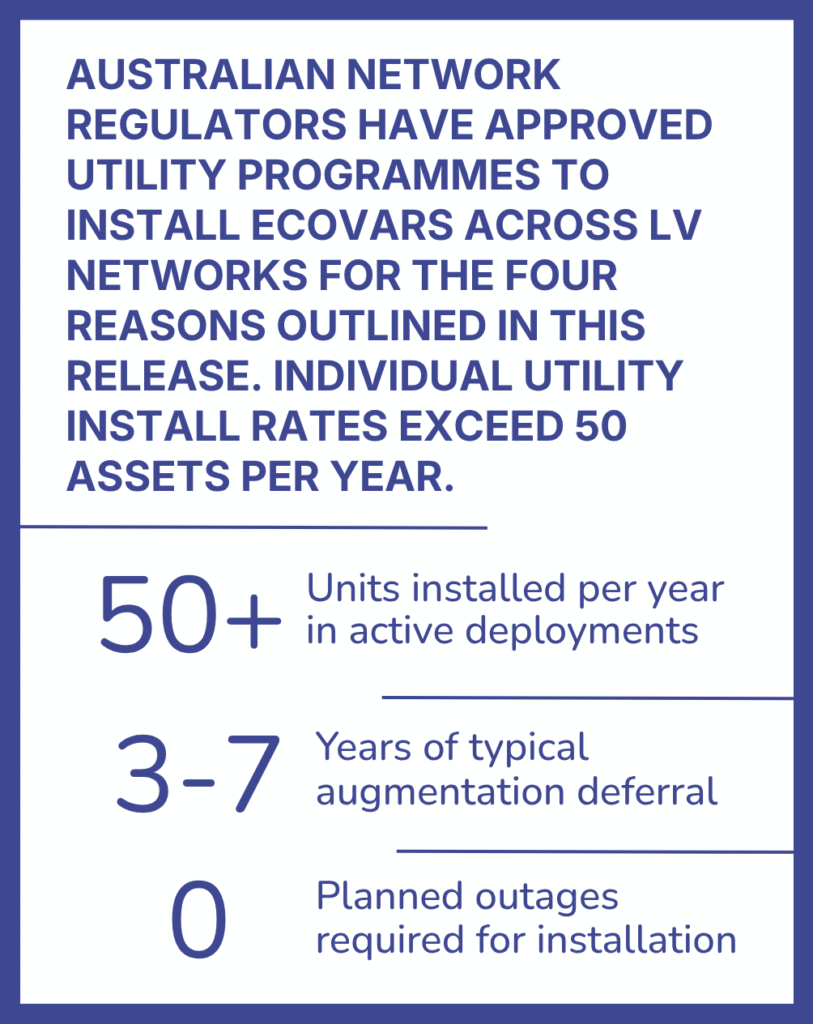
| Installation note: The EcoVAR’s 800 VDC secondary bus architecture enables connection directly to the LV overhead lines with no HV interruption, no planned outage, and no network access window required. Australian distribution utilities are commissioning EcoVAR units in a few hours, at a total installation cost of a few thousand AUD per unit. |
2. Manage dynamic and bidirectional loads: rooftop solar and EV charging simultaneously
The operating envelope that distribution equipment was designed for has changed. A residential feeder that once carried predictable morning and evening peaks now experiences reverse power flows during midday solar export, rapid load ramps as EV chargers cycle on and off, and voltage rise events that trip inverters and curtail generation. Static capacitor banks and fixed tap changers were not designed for this environment.
“The question for distribution planners is no longer whether to adopt dynamic compensation. It is how quickly existing feeders can be equipped to handle the resource mix that is already being connected.” — Dr Mike Wishart, CEO EcoJoule Energy
The EcoVAR operates as a fully dynamic compensator, responding to network conditions in under one cycle. It absorbs or injects reactive power continuously, suppresses voltage swings caused by variable generation, and provides active harmonic filtering to address the harmonic currents introduced by inverter-based resources and EV chargers. The result is a feeder that can accommodate significantly higher penetration of distributed energy resources without voltage limit violations, increasing the volume of solar generation that reaches end customers through existing infrastructure.
| Network-level impact: Voltage rise on congested feeders is the primary technical constraint limiting rooftop solar connection approvals. An EcoVAR installation directly expands the connection capacity of the feeder, reducing deferred solar connections and improving returns on existing network assets. |
3. True dynamic phase balancing: manual rebalancing is no longer a viable maintenance strategy
Phase balancing on LV overhead networks has historically been performed by a linesman crew travelling to the affected area, climbing poles, and physically disconnecting overhead line connections to individual properties before reconnecting them to a different phase. This is not a switchboard adjustment. It is live overhead work requiring traffic management, safety exclusion zones, and multiple crew members. A single rebalancing job across a suburban street can consume a full day of skilled labour and plant, at significant cost per intervention, before accounting for repeat visits as conditions change.
This approach had a reasonable basis when load profiles were stable and predictable, and when a survey conducted on a Tuesday morning could be relied upon to reflect typical conditions. It no longer does. On a modern LV feeder, a household’s net phase contribution changes sign between 11am and 6pm as rooftop solar generation gives way to EV charging. The phase that appeared lightly loaded during the morning survey may be the most heavily loaded by the time the crew reaches the end of the street.
Manual rebalancing performed against one set of conditions creates imbalance under another, and the cost of scheduling a return crew visit is non-trivial. Neutral current increases, transformer losses rise, and voltage deviation across phases widens, accelerating asset degradation and increasing energy costs for every customer on the feeder.
The EcoVAR resolves this because each internal phase operates independently, referenced phase-to-ground rather than phase-to-phase. The unit measures imbalance continuously and compensates in real time, injecting or absorbing current on each phase independently to maintain balance across the full 24-hour cycle, regardless of how the generation and load mix shifts throughout the day. There is no crew dispatch, no overhead line work, no residual imbalance between surveys, and no cost for a return visit.
| Asset life consequence: Voltage imbalance across phases introduces negative sequence currents whose losses are disproportionate to their magnitude, due to the lower impedance presented to negative sequence components. These currents cause localised winding heating in distribution transformers, where the Arrhenius relationship means ageing is exponentially accelerated with temperature. Even modest sustained hotspot increases measurably compress asset life. Dynamic phase balancing via EcoVAR reduces transformer thermal stress continuously over the asset life, compounding the return on installation. |
4. Active harmonic filtering: protecting network assets as device quality varies across the customer base
The proliferation of inverter-based devices — rooftop solar systems, EV chargers, variable speed drives, and consumer electronics — has fundamentally changed the harmonic profile of residential LV feeders. Many of these devices, particularly lower-cost units that drift into non-compliance after prolonged service in harsh conditions, generate significant harmonic currents that propagate through the network. These currents heat conductors and transformers beyond their rated thermal capacity, cause nuisance tripping of protective devices, and degrade power quality for neighbouring customers.
Distribution utilities cannot simply instruct affected households to replace their devices. The customers most likely to have purchased lower-cost equipment are also the customers for whom replacement costs are most prohibitive. Excluding these households from participation in rooftop solar and EV charging on the basis that their equipment has drifted out of compliance is not a viable social or commercial position for a utility to hold. The energy transition must be accessible to all energy users, not only those who can afford premium equipment or frequent replacements.
The EcoVAR provides active harmonic filtering as an integrated function, continuously measuring harmonic content on each phase and injecting compensating currents to cancel distortion at the point of common coupling. This protects transformers, cables, and switchgear from premature thermal degradation. Those are assets whose replacement cost is substantial, and whose loss of service is disruptive to all customers on the affected feeder.
| Asset protection framing: A single distribution transformer replacement typically costs tens of thousands to over $100,000 installed, excluding outage costs and customer compensation. Active harmonic filtering that extends transformer service life by even two to three years generates a return that is straightforward to quantify in any business case. |
RELATED
UK Power Networks — Content from this release supports EcoJoule’s contribution to the UK Power Networks innovation programme. See: Innovation on electricity poles helps drive UK toward Net Zero · UK Power Networks, 2024.
About EcoJoule Energy
EcoJoule Energy is headquartered in Loganholme, Queensland, Australia. The company designs and manufactures low voltage D-STATCOMs and Battery Energy Storage Systems for distribution network operators worldwide. The EcoVAR product family is pole-mounted on existing LV overhead infrastructure and provides reactive power compensation, active harmonic filtering, dynamic phase balancing, and voltage regulation from a single unit connected directly to each LV phase conductor. EcoJoule distributes through a global network of accredited utility partners and operates directly in selected markets. EcoJoule’s position is that the benefits of the energy transition should flow to all energy users, and that existing poles and wires, properly equipped, are the most cost-effective path to that outcome.
Media and technical enquiries: sales@ecojoule.com
Distributor and partnership enquiries: martin.vanderlinde@ecojoule.com