
The problem
When a large load switches onto a low-voltage feeder (a fast EV charger, a heat-pump compressor, a welding set, an irrigation pump), it draws a step change in current. That current flows through the upstream impedance of the supply: the distribution transformer, the LV main, and the service conductor. On a weak network (high source impedance, low fault level) the resulting voltage drop is large enough to be seen as a sag at the point of connection and at neighbouring premises.
The drop is approximated by:
ΔV ≈ (P·R + Q·X) / V
Two features of LV networks make this acute. First, the inrush of motors and switched-mode loads is reactive-heavy, so Q is momentarily large. Second, most large LV loads are single-phase, so the sag, and the voltage unbalance that comes with it, appears on one phase while the others are largely unaffected.
Conventional responses are poorly matched to the problem. Switched capacitor banks produce reactive output that falls with the square of voltage, giving least support exactly when voltage is depressed, and they cannot act per phase or respond within a cycle. On-load tap changers are too slow for switching events and act on the whole feeder rather than the affected phase. Reconductoring removes the constraint but requires capital and an outage.
How the EcoVAR responds
The EcoVAR is a shunt-connected LV distribution STATCOM. It measures voltage continuously and injects a controlled current at the point of connection to oppose the disturbance. Three characteristics matter for switching sags.
Current-source behaviour
As a voltage-source converter under closed-loop control, the EcoVAR’s injected current is set by its controller, not by the line voltage. Unlike a capacitor, its support does not collapse as voltage falls; it holds its commanded output through the sag, up to its rating.
Per-phase injection
The EcoVAR controls each phase independently. When a single-phase load causes an unbalanced sag, it supports the affected phase and corrects the unbalance without disturbing the other two — something a positive-sequence or three-phase-balanced compensator cannot do.
Fast closed-loop response
Power-electronic switching lets the converter react within a few cycles, fast enough to arrest the step a switching load produces rather than ride it out.
Because the same converter also performs active harmonic filtering, a load that both depresses voltage and injects harmonics (a drive or a charger) is addressed by one device.
What to expect, and how it scales
Reactive shunt compensation acts on voltage through the network reactance, X. The EcoVAR is strongest where the sag is reactive-dominated (motor inrush, switching transients) or unbalanced — which covers most LV switching events, and where per-phase injection corrects the sag and the unbalance together.
Where a sag is instead driven by a sustained, largely balanced real-power draw on a resistive feeder, reactive injection alone has less to work with. The EcoVAR can then be upgraded with EcoSTORE storage to supply the real-power component alongside its reactive support, addressing the P·R term of the voltage drop directly while retaining per-phase voltage control, phase balancing and harmonic filtering. The connection point and platform are unchanged; the same asset scales from reactive support to combined real-and-reactive support as the network’s needs grow.
In deployment
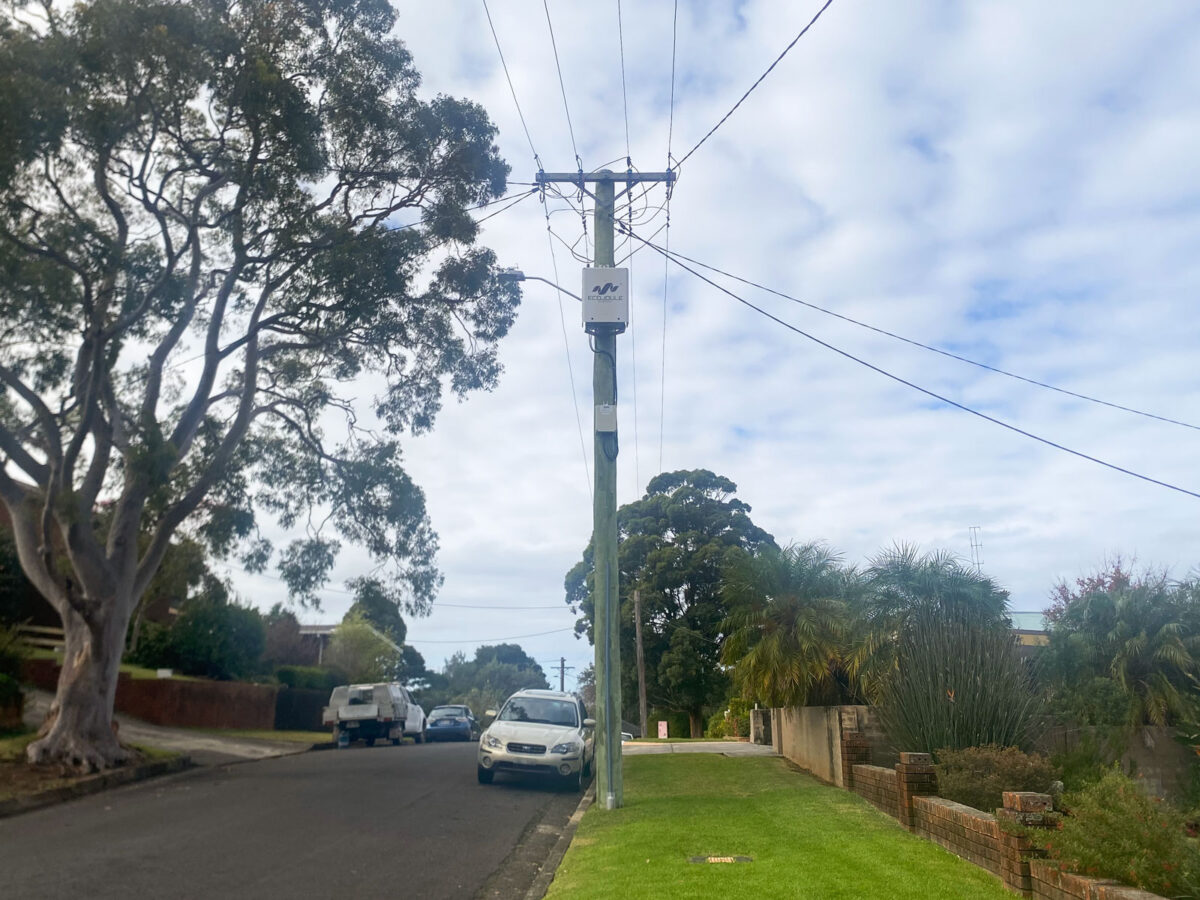
The EcoVAR installs without a network outage and retrofits to existing pole-mount (Alto) or ground-mount (Terra) sites. From a single shunt connection it provides per-phase voltage support, phase balancing and active harmonic filtering — relieving a switching-sag constraint without reconductoring or a transformer change.