
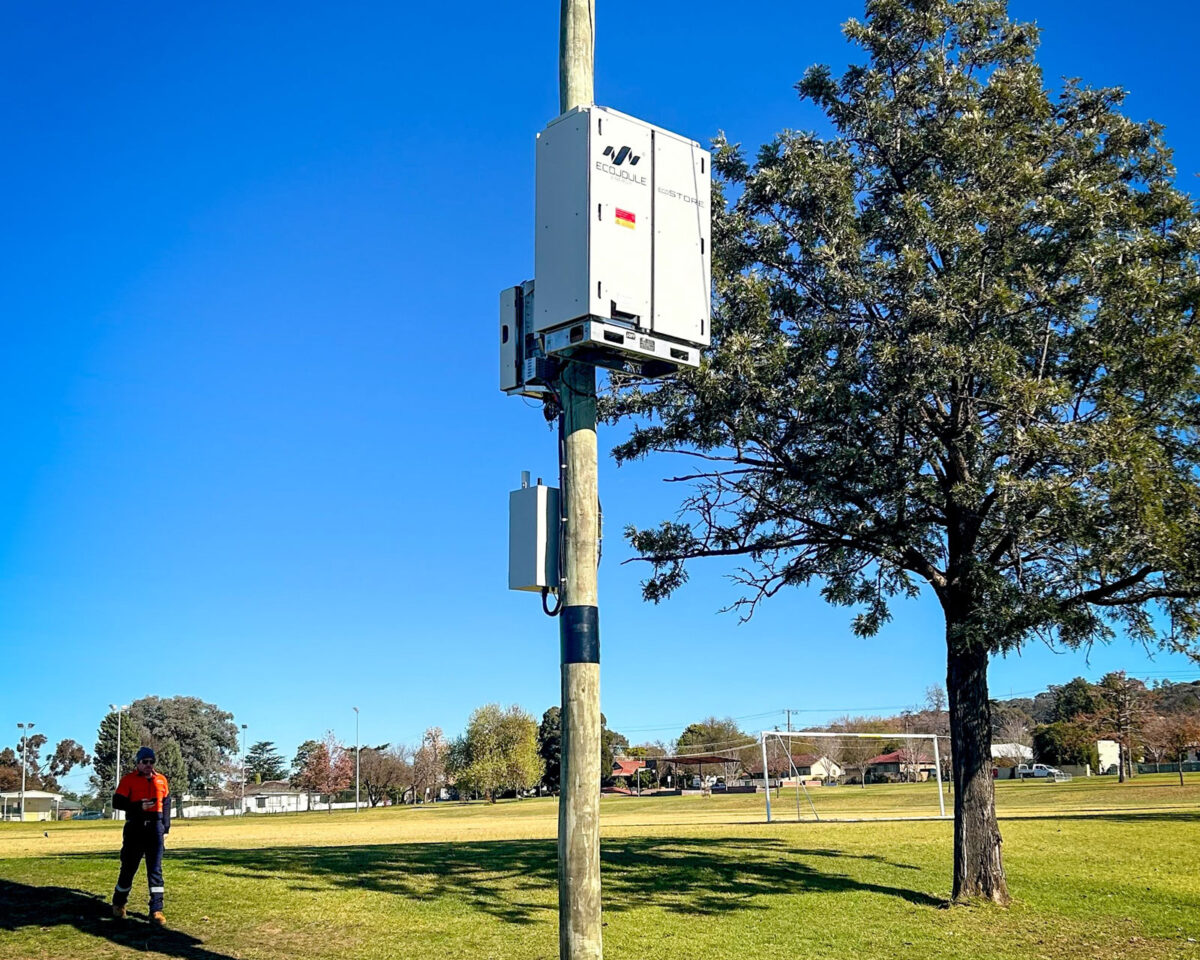
EcoJoule uses lithium iron phosphate (LFP) cells in its battery energy storage systems. This bulletin sets out the fire-relevant differences between LFP and lithium nickel manganese cobalt oxide (NMC) cells, and the protection layers the EcoSTORE adds on top of cell chemistry.
LFP Key figures
Negligible
Oxygen released by LFP cathode on breakdown
NMC: releases oxygen
350–650 °C
LFP peak cell temperature in runaway
NMC: 550–900 °C
220–250 °C
LFP thermal runaway trigger temperature
NMC: 150–220 °C
None
Nickel or cobalt in LFP cells
NMC: both
What the data shows
Compared with NMC, LFP cells:
- release negligible oxygen when the cathode breaks down, so the cell does not feed its own fire
- reach a lower peak temperature and release heat more slowly, making cell-to-cell propagation less likely and slower
- begin thermal runaway at a higher temperature, giving more margin before a fault becomes self-sustaining
- contain no nickel or cobalt, and have a longer cycle life
LFP has lower energy density than NMC. For stationary network equipment, weight and volume are secondary to safety and service life, so this trade-off favours LFP.
Why this matters on the distribution network
Distribution-connected batteries sit on poles, footpaths and road reserves, close to homes and the public, and are usually unattended. The consequence of a fire at these sites is high, so EcoJoule reduces the likelihood of one at the source by selecting LFP.
LFP is not non-combustible.
Its electrolyte and vent gas are flammable. Cell chemistry is the first layer of protection in the EcoSTORE, not the only one. The layers that follow it are set out here.
Fire-relevant characteristics of NMC and LFP
| Characteristic | NMC | LFP | Relevance |
| Cathode structure [4] | Layered metal oxide | Olivine phosphate with strong phosphorus–oxygen bonds | Determines thermal stability of the cathode |
| Oxygen release on cathode breakdown [4] | Yes. Released oxygen supports combustion inside the cell | Negligible | Oxygen release makes an NMC fire self-sustaining and difficult to suppress |
| Thermal runaway trigger temperature* [2,3,11] | Approx. 150–220 °C, lower for high-nickel variants | Approx. 220–250 °C | Higher trigger temperature gives more margin before runaway becomes self-sustaining |
| Peak cell temperature in runaway* [1,5,11] | Approx. 550–900 °C | Approx. 350–650 °C | Lower peak temperature reduces heat transfer to adjacent cells |
| Rate of heat release [3,9] | High | Low to moderate | Governs the speed of escalation |
| Cell-to-cell propagation [2,4] | More likely and faster | Less likely and slower | Propagation turns a single-cell fault into a module or system fire |
| Vent gas [6,7,8] | Larger volume per Ah, flammable, CO-rich | Smaller volume per Ah, flammable, H2-rich, with a lower flammability limit | Unignited gas can accumulate, so enclosure ventilation and deflagration management are required for both. Vent gas from both is toxic |
| Cell energy density* [10] | Approx. 190–275 Wh/kg | Approx. 140–205 Wh/kg (current cells) | Lower density is acceptable in stationary network equipment |
| Cycle life | Lower | Higher | Supports long-life network assets |
| Nickel and cobalt content | Yes | No | Supply-chain and end-of-life considerations |
* Indicative ranges from the references below. Actual values depend on cell format, state of charge, age and manufacturer. Trigger temperature is the point at which runaway becomes self-sustaining; measurable self-heating begins earlier, at approx. 90–110 °C for NMC and 150–170 °C for LFP [12].
How the EcoSTORE manages the residual risk
Pole-mount EcoSTORE units apply eight protection layers. Layers 3 and 4 act independently of each other, so a single failure does not remove thermal protection [13].
| Layer | Mechanism | Effect |
| 1 Cell chemistry | LFP cells (Table 1) | Lowers the likelihood of thermal runaway and of propagation between cells |
| 2 Cell temperature monitoring | The BMS measures the temperature of every cell and reports it to the inverter | Cell-level thermal data for both protection layers below |
| 3 Inverter derating | Battery current ramps down linearly from full output at 45 °C to zero at 60 °C | Charge and discharge current is removed before cells reach 60 °C |
| 4 BMS disconnection | The BMS independently disconnects the batteries above 65 °C, the cells’ rated limit | Second, independent thermal protection |
| 5 Module fusing | Fuses in each battery module open under short circuit | Removes a battery short circuit and arc flash as an ignition source |
| 6 Cell pressure vents | Each cell has a designed vent that opens above a set internal pressure | Releases gas before cell pressure reaches a hazardous level |
| 7 Thermal management | Fans draw air in at the base, across the modules and out through side vents. Heat shields with a convective air gap cover the enclosure | Holds enclosure temperature close to ambient and limits solar heating |
| 8 Enclosure | AISI 304 stainless steel. A 4 mm back shields the pole. The inverter sits in a separate cabinet. | Improved containment under unlikely failure mode. Separates a battery event from the pole and the inverter |
Safe approach guidance
EcoJoule recommends that network operators build the following checks into safe-work procedures before crews access an operating EcoSTORE [13]:
- Review the unit’s recorded temperatures for the previous 24 hours for abnormal readings.
- Inspect from a distance for smoke or flame at the exhaust vents, heat haze above the unit, or distorted panels.
- From at least 3 m, measure the enclosure surface temperature on at least two sides with an infrared thermometer, then act on the result:
| Surface temperature | Action |
| Below 75 °C | Safe to approach. Wear gloves when opening or handling panels |
| 75–100 °C | Risk of burns on contact. Wait at least 30 minutes, re-measure and reassess |
| Above 100 °C | Treat as unsafe and a possible thermal event. Confirm the unit is isolated from the grid, set an exclusion zone, post observers to prevent approach, and complete a risk assessment before any further action |
ABOUT ECOJOULE ENERGY
EcoJoule Energy designs and manufactures low-voltage grid-edge power electronics in Brisbane, Australia. Its EcoVAR LV D-STATCOM is in field service with distribution utilities in Australia and internationally, and is available in pole-mount (EcoVAR Alto) and ground-mount (EcoVAR Terra) variants. EcoJoule’s technology relieves grid congestion and increases network hosting capacity, allowing the benefits of the energy transition to reach more users of the existing distribution network.
References
[1] Golubkov A.W. et al., “Thermal-runaway experiments on consumer Li-ion batteries with metal-oxide and olivin-type cathodes”, RSC Advances 4 (2014) 3633–3642. https://doi.org/10.1039/C3RA45748F
[2] “Thermal and mechanical safety assessment of type 21700 lithium-ion batteries with NMC, NCA and LFP cathodes – investigation of cell abuse by means of accelerating rate calorimetry (ARC)”, Batteries 9(5) (2023) 237. https://doi.org/10.3390/batteries9050237
[3] “Comparison on thermal runaway and critical characteristics of cylindrical lithium-ion batteries: a review”, ACS Chemical Health & Safety. https://doi.org/10.1021/acs.chas.4c00121
[4] “Thermal runaway propagation in automotive lithium-ion batteries with NMC-811 and LFP cathodes: safety requirements and impact on system integration” (2023). https://www.sciencedirect.com/science/article/pii/S2590116823000802
[5] “Evaluation of the laminar burning velocity of various battery vent gases emitted during the thermal runaway of Li-ion cells” (2025). https://www.sciencedirect.com/science/article/pii/S0950423025001159
[6] “NVPF sodium-ion versus NMC and LFP lithium-ion batteries in thermal runaway: vent gas composition and thermal analysis”, Batteries 11(9) (2025) 323. https://www.mdpi.com/2313-0105/11/9/323
[7] “Review of gas emissions from lithium-ion battery thermal runaway failure — considering toxic and flammable compounds”, Journal of Energy Storage (2024). https://www.sciencedirect.com/science/article/pii/S2352152X24008739
[8] “Thermal runaway characteristics and gas composition analysis of lithium-ion batteries with different LFP and NCM cathode materials under inert atmosphere”, Electronics 12(7) (2023) 1603. https://www.mdpi.com/2079-9292/12/7/1603
[9] “Thermal runaway characterization of cylindrical lithium-ion and sodium-ion batteries with various sizes and energy contents”, Journal of Power Sources (2025). https://www.sciencedirect.com/science/article/pii/S0378775325010766
[10] PowerUp / CEA-Liten, “NMC vs LFP: safety and performance in operation” (2025). https://powerup-technology.com/nmc-vs-lfp-safety-and-performance-in-operation/
[11] Electric & Hybrid Vehicle Technology International, “LFP vs NMC thermal runaway” (2025). https://www.electrichybridvehicletechnology.com/technical-articles/lfp-vs-nmc-thermal-runaway.html
[12] Battery Design / Akkuracy Battery Testing, “Objective safety analysis of NMC vs LFP” (2026). https://www.batterydesign.net/objective-safety-analysis-of-nmc-vs-lfp/
[13] EcoJoule Energy, “EcoSTORE battery fire / explosion risk reduction and mitigation” (2023). Available on request.