
A feeder is only as compliant as its worst phase.
Low-voltage planning has long been able to treat a feeder as a balanced three-phase circuit. For most of the network’s history that was a safe assumption. High penetrations of single-phase distributed generation and single-phase load are ending it, and they do so in a way an aggregate check doesn’t catch.
Voltage compliance is assessed per phase. In Australia, the nominal is 230 V with a range of +10% / −6% (AS60038 and AS61000.300.1), and each phase at the point of supply has to sit inside that range, not the average of the three, each one independently.
Single-phase connections are where this bites. A rooftop inverter or an EV charger connects to one phase, not three. At low penetration the connections diversify across phases and across the day, and the feeder behaves close to balanced. At high penetration that diversity fails. PV exports on the phases it happens to sit on through the middle of the day; EV charging loads other phases through the evening. One phase is pushed toward the upper limit at midday while another is dragged toward the lower limit at the evening peak.
The trap is that the three-phase average can look compliant while an individual phase is in breach. A planner working from aggregate feeder loading, or from a balanced load-flow assumption, sees headroom that isn’t there.
This is not only a high-solar story. Any concentration of single-phase power-electronic load does the same thing from the other direction. EV charging, and increasingly induction cooking, draws hard on whatever phase it happens to be wired to. A network with modest rooftop PV but rising electrification will see the same per-phase divergence, driven by load rather than generation. The mechanism is the connection being single-phase, not whether it imports or exports.
The instinct is to reach for conductor augmentation. Larger conductor lowers impedance, and lower impedance does reduce the magnitude of voltage excursions. That part is real. But it reduces them symmetrically. It does nothing about the asymmetry between phases, and nothing about the time-of-day variation that drives the swing. Conductor is a fixed impedance: it cannot pull a phase down at midday and hold it up at the evening peak. To bring a single over-voltage phase back inside the limit by impedance alone, you would oversize the conductor well beyond the thermal load — paying for capacity you don’t need to address a problem conductor was never the right tool for.
Behind-the-meter batteries are sometimes offered as the answer. For a network planner they are not, because they cannot be centrally controlled, and they are also usually a single phase device, doing which does not fix feeder balance. A customer’s battery cannot be dispatched to hold a phase within limits, and it cannot be counted on for compliance.
A STATCOM put in now is not interim spend to be written off when the larger upgrade arrives.
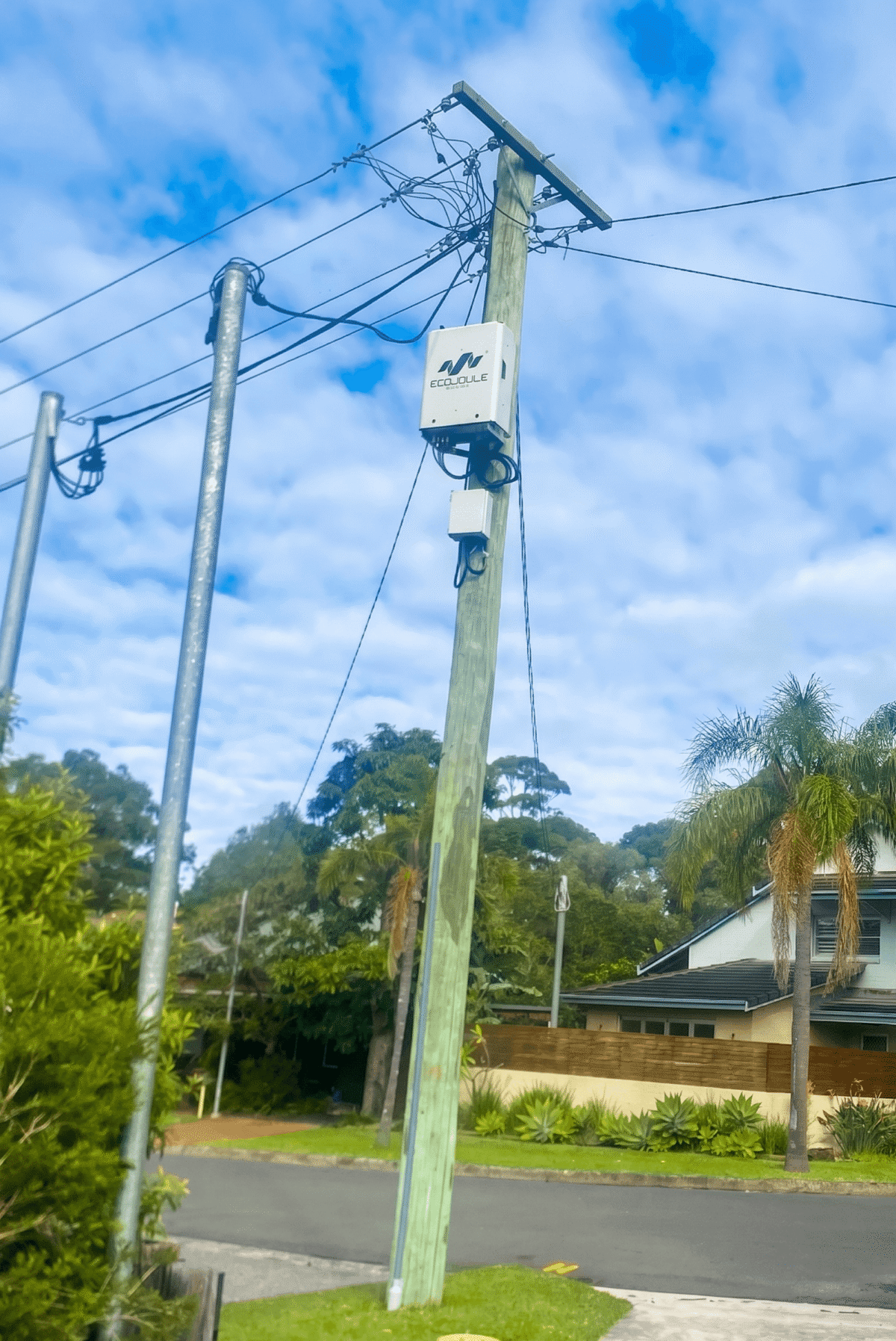
What corrects a per-phase, time-variable problem is per-phase, dynamic control. An LV D-STATCOM regulates each phase independently and continuously: absorbing reactive power on the phase running high, supplying it on the phase running low, and rebalancing load across the three phases. It tracks the daily cycle rather than being tuned to a single condition.
There is a second consequence worth naming. Because a feeder is limited by its worst-loaded phase, unbalance leaves real capacity stranded, two phases can sit well under their limit while the third sets the constraint. Rebalancing recovers that capacity and lets a network use conductor it already owns to its actual rating. That is what defers augmentation, rather than simply delaying it.
None of this replaces augmentation, and augmentation does not replace it. They sit on the feeder as two layers doing two jobs. New conductor adds thermal capacity and lowers impedance; it does not balance phases, filter harmonics, regulate voltage through the day, or report the power-quality conditions where it sits. Those functions do not arrive with copper, and they do not stop being needed once copper is installed. The capacity an upgrade unlocks tends to fill with more of the single-phase load and generation that drove the divergence in the first place.
So a STATCOM put in now is not interim spend to be written off when the larger upgrade arrives. It is the control layer that keeps a feeder balanced and compliant before augmentation, through it, and after it. Where the constraint is genuinely thermal and the conductor cannot carry the current, augmentation is the right answer. The STATCOM stays in service, doing the work the new conductor was never going to do. The two are complementary by design.
The per-phase compliance trap is not a future problem. It is already visible on high-penetration feeders that pass an aggregate check and fail a per-phase one. Worth checking which of yours do.