
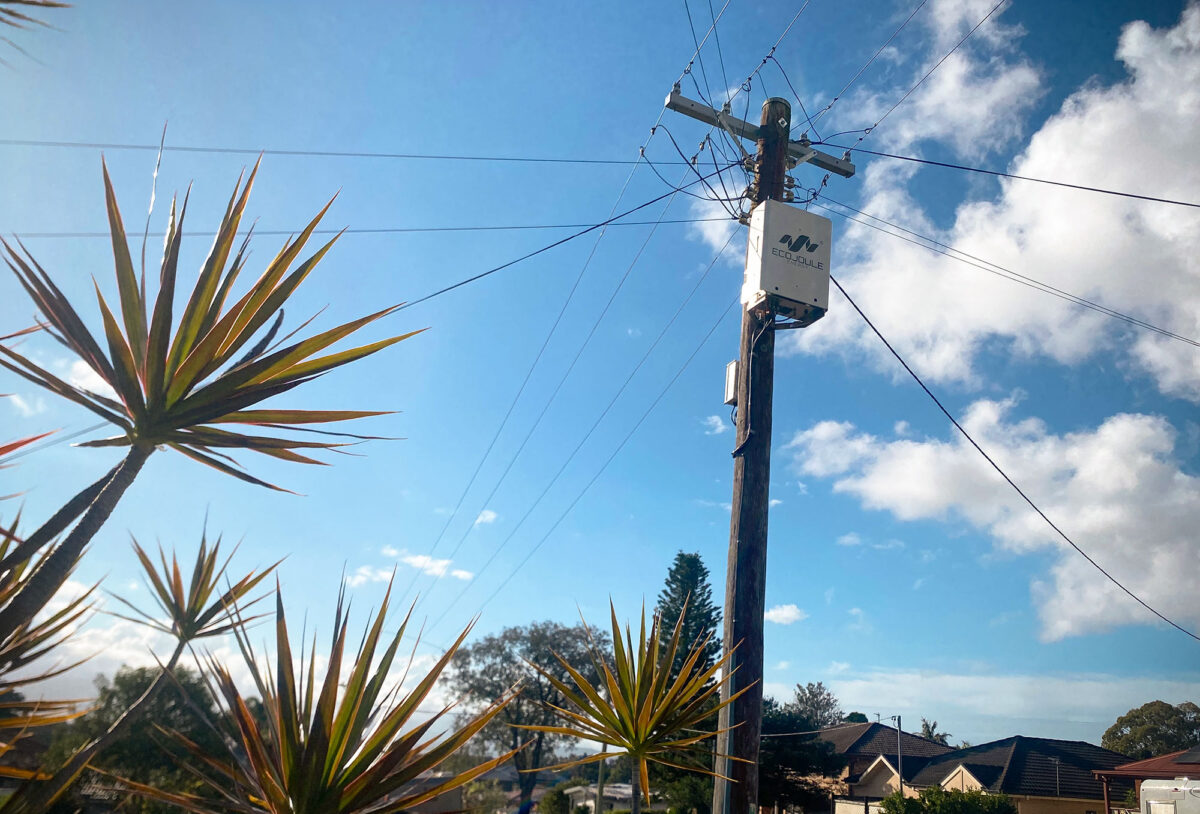
How a STATCOM connects to the LV network is a work-practices decision, not a technical one. The unit performs identically across every arrangement below — what changes is only how technicians isolate and power it down.
The shunt connection
A low voltage distribution STATCOM, such as the EcoVAR, connects to the LV feeder as a shunt device — it taps the network in parallel rather than in series. The feeder continues to carry its normal load; the STATCOM draws from the same connection to inject or absorb reactive current per phase. Because the connection is parallel, the feeder does not need to be de-energised to connect or remove the unit. Only the shunt tap point is worked, so there is no customer outage to bring a STATCOM into or out of service.
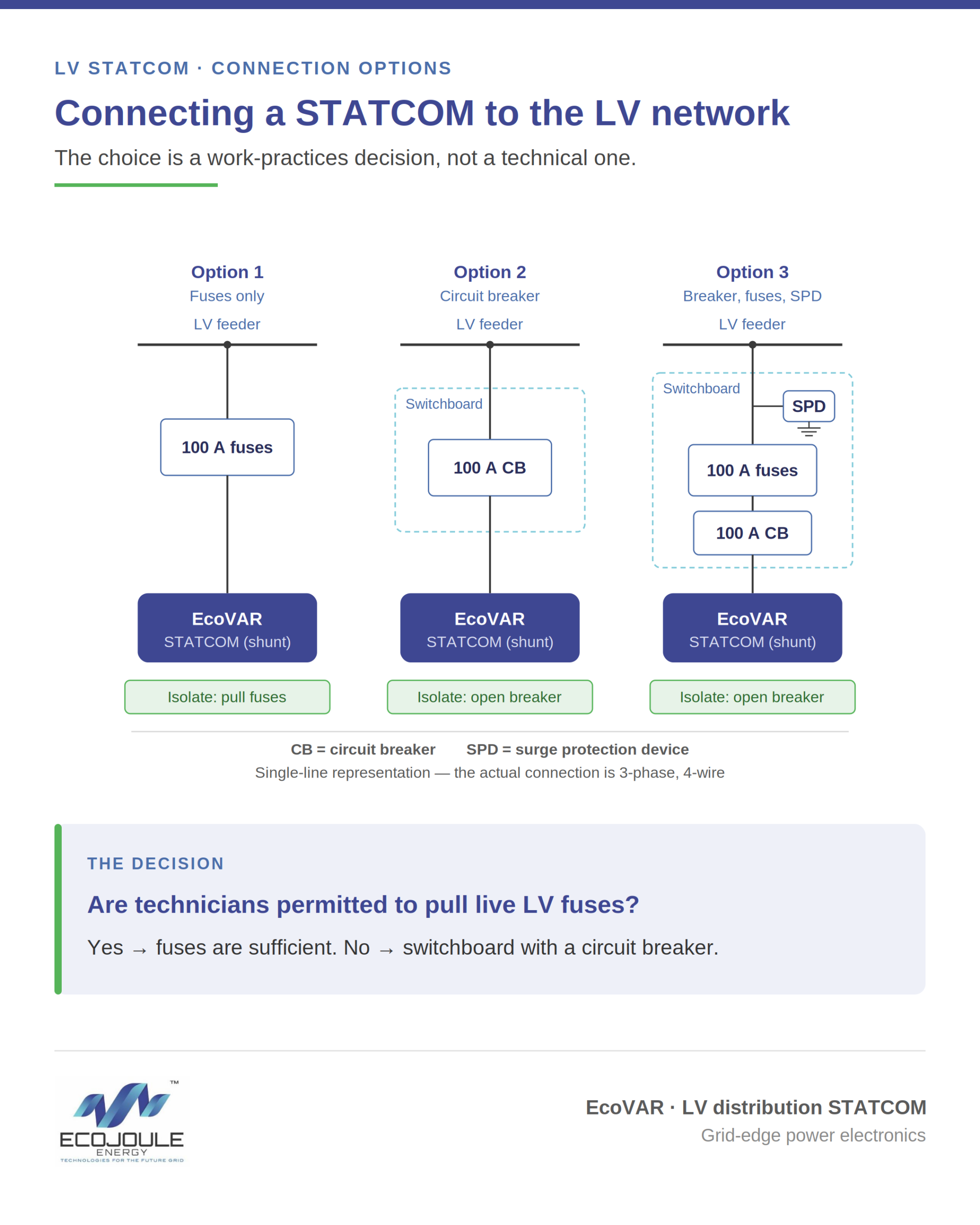
Every shunt connection needs a device between the STATCOM and the feeder that provides overcurrent protection and a means of isolation. Three arrangements are common. The choice is driven by the utility’s work practices and risk appetite — not by any difference in how the STATCOM performs. All three deliver identical operation.
Option 1 — Outdoor fuses
The lowest-cost method is a set of outdoor fuses, rated at 100 A, connecting the STATCOM to the overhead line on the shunt circuit.
The 100 A rating reflects the EcoVAR’s operating profile and its thermal environment. Full rated current is 63 A continuous, with a short-time capability of 1.5 × rated (about 95 A) under fault conditions. Most off-the-shelf MCBs derate their current rating at elevated ambient temperatures; at the EcoVAR’s 50 °C maximum, a marginally-sized breaker could trip spuriously at full output. Rating the device at 100 A holds margin above the derated threshold, so it carries full load without nuisance operation while remaining low enough to protect the connection. The rating is standardised at 100 A for both the fuse and circuit-breaker arrangements.
This is the fastest, simplest and most economical arrangement, with the fewest components in the circuit and therefore the fewest potential points of failure. Isolation is achieved by pulling the fuses. Because the STATCOM draws its operating supply from the same connection, removing the fuses is also the only way to override the unit and power it down.
The constraint is operational: some utilities’ work practices prohibit technicians from pulling live LV fuses. Where that rule applies, fuses alone are not a workable isolation method.
Option 2 — Switchboard with circuit breaker
For utilities that do not permit live fuse pulling, the connection is made through a small outdoor switchboard on the shunt circuit, between the STATCOM and the LV feeder. The switchboard houses a circuit breaker rated at 100 A.
The circuit breaker is a load-break device. It provides a rated switching point that brings the STATCOM in and out of service without pulling fuses, satisfying work practices that prohibit live fuse operation. The trade-off is one additional component and the associated cost, in exchange for an operator-friendly switching point.
Option 3 — Switchboard with circuit breaker, fuses and surge protection
The most conservative utilities add backup fuses and surge protection to the switchboard. The fuses provide backup overcurrent protection and fault coordination; the surge protection guards against transient overvoltages entering from the LV network.
This should be weighed carefully. Every additional device is a potential point of failure and a maintenance item. The marginal protection gained needs to be balanced against reduced overall reliability, a larger enclosure, and higher lifecycle cost.
Choosing an arrangement
The STATCOM operates the same way in all three cases. Match the connection arrangement to your work practices and your risk appetite, and avoid adding components whose protection you will not use. For most utilities the decision comes down to a single question: are technicians permitted to pull live LV fuses? If yes, fuses are sufficient. If no, a switchboard with a circuit breaker is the practical minimum.