
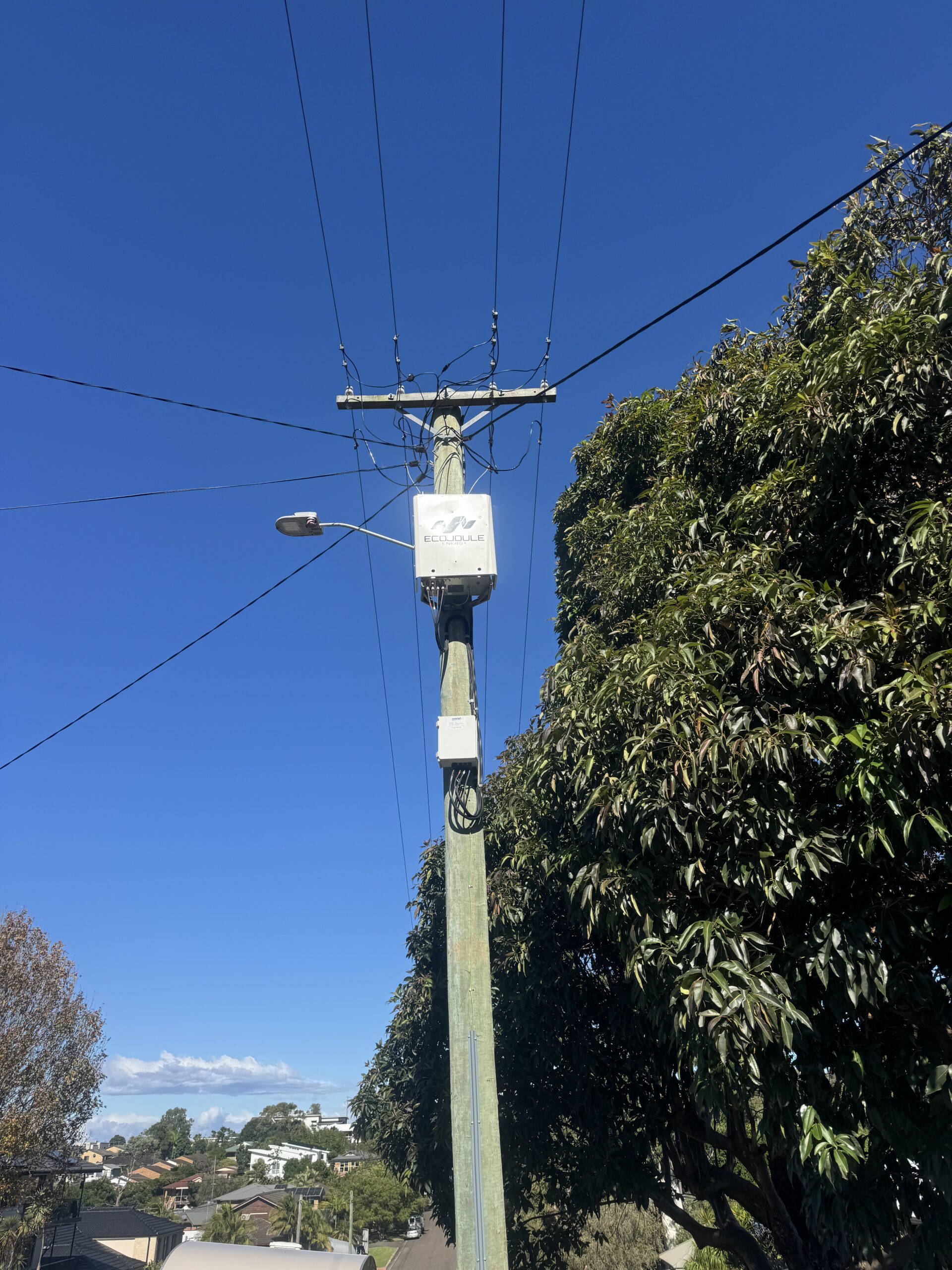
A plain-language guide to the device that holds voltage steady on the low-voltage grid — and lets existing poles and wires carry more solar.
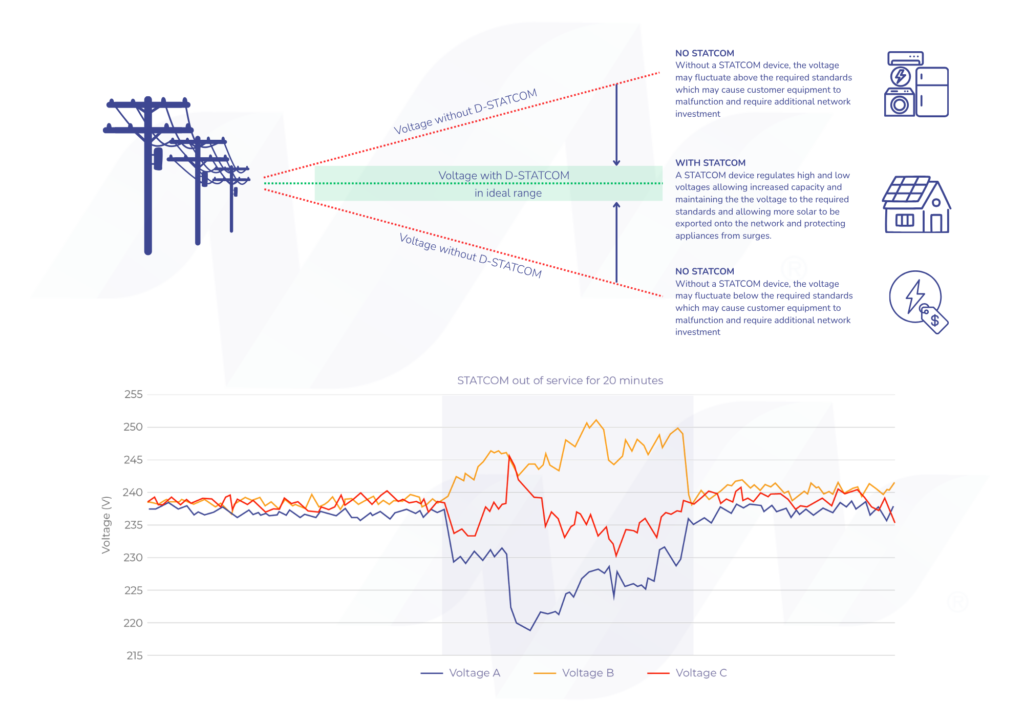
A distribution STATCOM (D-STATCOM) is a power-electronic device connected to the low-voltage (LV) network to regulate voltage. It does the job of a voltage regulator, but instead of switching taps or capacitor steps, it exchanges reactive power with the grid continuously and adjusts within a fraction of a mains cycle. That speed, and the resolution it brings, is what separates it from conventional correction equipment.
An Advanced Voltage Regulator
At its core, a D-STATCOM is a voltage-source converter. By controlling the magnitude and phase angle of its output voltage relative to the grid, it either sources reactive power to raise local voltage, or sinks reactive power to lower it. There are no discrete steps. The output is variable across its full range, so the converter can hold voltage at a target rather than bracketing it between tap positions.
Advanced LV units control each phase independently. This matters on the LV network, where single-phase rooftop solar, EV charging and uneven load routinely pull the three phases apart. A per-phase controller corrects each phase to its own target instead of applying one average correction across all three.
Sub-Cycle Response and Active Harmonic Filtering
A D-STATCOM samples and adjusts its output many times within a single 50 Hz cycle. This sub-cycle response lets it track fast voltage variations that step-based equipment cannot follow.
The same capability allows it to act as an active harmonic filter. Non-linear loads inject harmonic currents that distort the voltage waveform. Because the converter can shape its output within the cycle, it synthesises a waveform that drives a compensating current — equal in magnitude and opposite in phase to the harmonic content already on the network — so the two cancel at the point of connection. The result is a cleaner voltage waveform without the tuned, passive filter banks that conventional approaches rely on.
Connected in Parallel, Not Series
A D-STATCOM is connected in shunt (parallel) with the network, not in series with the load. It injects current at its point of connection rather than carrying the line current through itself.
This is the reason a relatively low-power STATCOM can have a large effect on voltage. On an electrically weak network — long feeders, small conductors, high source impedance — a modest injection produces a meaningful voltage change. A small shunt device therefore moves voltage far more than its rating alone would suggest, precisely where the network is least able to support itself.
FOR THE TECHNICALLY MINDED
ΔV ≈ (R·ΔP + X·ΔQ) ÷ V
The voltage change at a point depends on both the resistance (R) and reactance (X) of the network. The LV grid R/X ratio is higher than medium voltage, increasing active power (ΔP) voltage leverage— which sets up the next capability.
Why LV STATCOMs Are Gaining Ground
High renewable penetration is changing where instability shows up on the grid. Voltage rise from clustered rooftop solar, imbalance from single-phase connections, and harmonics from inverters now originate inside the LV network, close to the customer. Two factors are driving adoption:
- Cost. Compared with conductor upgrades, additional transformers, or large centralised compensation, a distributed LV STATCOM is a lower-cost way to manage these conditions — and the EcoVAR installs with no outage required.
- Location. A shunt LV device applies regulation and reactive power at the source of the problem, on the feeder where the issue arises — rather than generating reactive power upstream and pushing it down the line alongside real power, loading the very conductors it is meant to relieve.
By correcting voltage, balancing phases and filtering harmonics locally, the LV STATCOM frees up capacity on existing poles and wires. That lets more solar generation reach more customers without the cost and disruption of rebuilding the network.