

As rooftop photovoltaic (PV) penetration rises across residential and commercial low voltage (LV) networks, distribution planners increasingly face the question of whether smart inverter volt-var functions are sufficient to maintain voltage stability and power quality. This article examines the fundamental limitations of PV inverter reactive power capability and explains why a dedicated distribution-level Static Synchronous Compensator (D-STATCOM) — grid-connected and independent of local solar generation — is required to provide reliable, continuous voltage and power quality support.
1. The Inverter Apparent Power Constraint
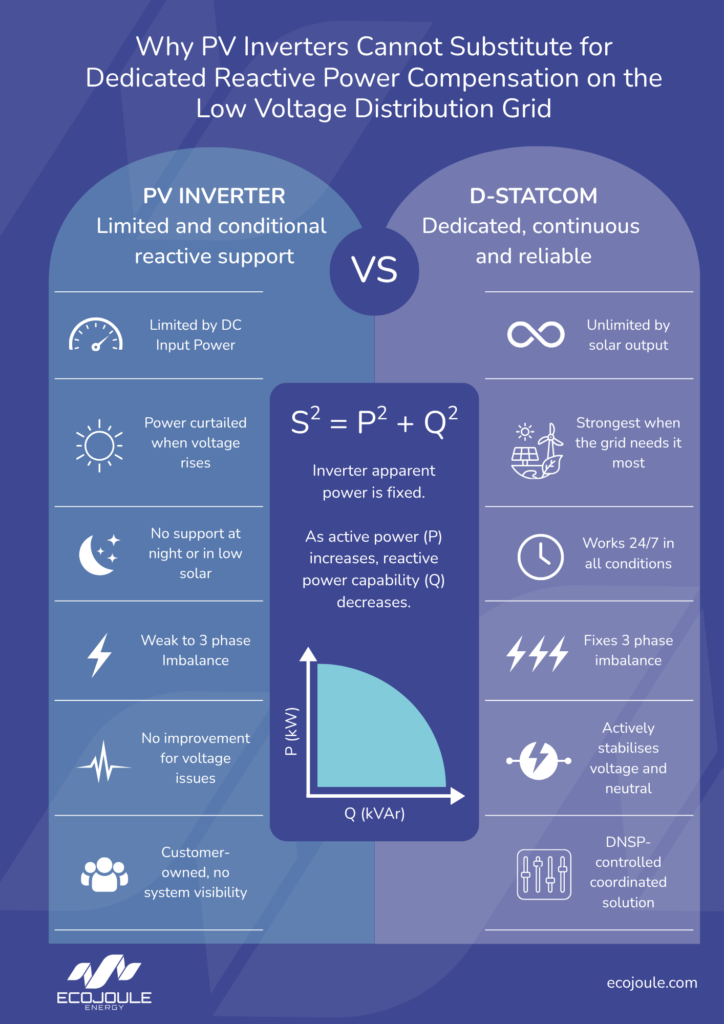
A grid-connected PV inverter is a current source converter rated to a fixed apparent power (S, measured in kVA). The relationship between active power (P), reactive power (Q), and apparent power is governed by:
S² = P² + Q²
Because S is fixed by the inverter’s hardware rating, any reactive power the inverter delivers comes directly at the expense of active power output. When a PV system is generating at or near its rated capacity — exactly the conditions under which voltage rise and overvoltage events are most acute — the inverter has minimal remaining capacity available for reactive compensation.
Research published in Scientific Reports (2025) quantifies this constraint precisely: the inverter must manage its limited apparent power capacity between delivering active power and supplying reactive support, and this trade-off becomes especially important during peak solar output, when the inverter may prioritise active power and limit reactive contribution [1].
The practical consequence is that grid support from PV inverters is weakest precisely when the grid needs it most — at midday under high irradiance and high reverse power flow.
2. No Support When Solar Generation Is Absent
Voltage and reactive power demand on the distribution grid do not follow a solar schedule. Evening peak loads driven by air conditioning, cooking and electric vehicle (EV) charging create reactive demand that is structurally disconnected from daytime solar generation.
Conventional customer-owned grid-tied inverters are inactive at night and produce negligible output under heavy cloud cover or during winter months. When an inverter is not generating, it cannot provide reactive power unless it is specifically designed and configured to operate in a standby STATCOM mode — a capability that is not standard in residential or small commercial inverters, and one that requires a connected DC source to maintain the DC link voltage.
Research cited by Oxford’s Clean Energy journal (2022) confirms that while PV inverters can technically be operated at night to provide reactive support, there are no standard policies or incentives to operate them in this mode, and the operational frameworks to do so are not in place for distributed residential assets [2].
A dedicated D-STATCOM, by contrast, draws its reactive power from the AC line itself. It requires no local generation source. A voltage source converter (VSC) uses a small DC capacitor to synthesise leading or lagging reactive current — it neither consumes nor generates active power — and is therefore available on a 24/7 basis, regardless of irradiance, cloud cover, season, or time of day.
3. Phase Imbalance and Neutral Voltage Displacement
The majority of residential solar installations in four-wire LV distribution networks are single-phase connected. Where uptake is uneven across the three phases of a feeder — which is the typical real-world condition, not the exception — the result is a phase imbalance that displaces the neutral voltage from its reference point.
This neutral point shift is not a benign condition. Research published in IEEE-indexed literature has documented that single-phase DG units in LV networks cause neutral-point shifting, with a side effect that voltage in phases adjacent to the high-generation phase can decrease, creating the potential for undervoltage events on other phases [3]. A separate study published in IEEE Transactions on Smart Grid confirms that unbalanced and resistive LV networks can exhibit positive inter-phase voltage sensitivity terms, acting as destabilising positive feedback loops after individual inverter tripping events [4].
The critical failure mode is a cascade: when neutral voltage shifts, the phase-to-neutral voltage seen by single-phase inverters on the affected phases moves outside the limits specified in inverter protection standards (such as AS4777 in Australia and equivalent IEC standards internationally). Inverters detect an apparent overvoltage or undervoltage condition and disconnect. Each disconnection reduces generation on that phase, which may worsen the imbalance on others. The result is potential rapid shedding of multiple inverters across the feeder, further destabilising voltage and leaving the grid with a substantially reduced generation fleet at no notice.
A three-phase D-STATCOM connected at the feeder level addresses this failure mode directly. By drawing unequal reactive currents from each phase to compensate for the uneven generation and load across phases, the STATCOM actively restores neutral voltage to its reference. It provides a fixed, stable phase-to-neutral reference for all single-phase inverters connected downstream — a reference that does not shift with load or generation imbalance. This stabilises the operating environment for every customer-owned PV inverter on the feeder, allowing them to remain connected and productive.
Field data from Endeavour Energy’s DER Integration Strategy supports this analysis. Their LV analytics tools identified high daytime DER-related phase unbalance as a primary network stress condition, and noted that single-phase voltage rise caused by PV is amplified by the influence of the neutral conductor [5]. Endeavour are in a multi-year deployment of a fleet of LV STATCOMs as proven, business-as-usual solutions for voltage management on constrained feeders, forecasting a population of 240 units by the close of the 2029 regulatory period [5].
4. High Power Single-Phase Loads: The Compounding Problem
The challenge of neutral voltage management is not limited to PV generation. The same distribution feeders that are absorbing rooftop solar are also experiencing growing loads from air conditioning, induction cooking and, increasingly, residential EV charging. A household running a 6 kW split-system air conditioner simultaneously with a 7 kW EV charger on a single phase represents a 13 kW load imbalance contribution from one connection point.
These high single-phase loads draw both active and reactive power. Air conditioning compressors are inductive loads with power factors typically in the range of 0.7–0.85, meaning they draw significant reactive current in addition to their active demand. This reactive demand cannot be addressed by PV inverters: they may be on a different phase, they may be offline at night, and even if active they have no mechanism for measuring or responding to a neighbour’s reactive demand.
A D-STATCOM monitors the aggregate reactive current on each phase at its point of connection and injects equal and opposite reactive current to compensate — whether the reactive demand originates from air conditioning, motor loads, EV chargers, or the reactive losses in the feeder cables themselves. This compensation is instantaneous, continuous and independent of the source of the reactive demand.
5. AS4777 and the Australian Regulatory Context: “Do No Harm” vs. “Fix the Problem”
The regulatory framework governing grid-connected inverters in Australia is AS/NZS 4777.2, administered through the National Electricity Rules and enforced via the Clean Energy Council’s approved inverter list. AS4777 has been progressively updated — most recently to the 2020 version — to incorporate volt-watt and volt-var response modes, ROCOF withstand requirements, and tighter export limit controls [8].
These improvements are meaningful, but they reflect a fundamental design philosophy that can be described as “do no harm.” The standard’s primary objective is to ensure that inverters connected to the LV network do not actively worsen grid conditions — they must disconnect under abnormal voltage or frequency, ramp up softly on reconnection, and curtail output before causing overvoltage. The volt-var response mode, where enabled, asks an inverter to modulate its own reactive output in response to the voltage it sees at its own terminals.
This is a reactive and localised response. An inverter operating under AS4777 volt-var compliance is reacting to the voltage at its own connection point. It has no visibility of conditions on other phases, no awareness of neutral displacement developing elsewhere on the feeder, and no mechanism to inject corrective current in response to a neighbour’s inductive load. It is designed to avoid making its own situation worse — not to actively correct the network condition.
The distinction becomes critical under the conditions that are now becoming common across Australian LV networks: high concentrations of single-phase solar on unevenly loaded feeders, combined with growing single-phase loads from electrified appliances and EV charging. Localised voltage control techniques such as inverter volt-var control require no coordination but have limited effectiveness when PV penetration is high — a finding that holds regardless of how well individual inverters comply with AS4777 [9].
Neutral displacement — the condition in which unequal phase loading shifts the neutral point away from its reference — is not something any single-phase inverter can detect or correct under AS4777. Each inverter sees only its own phase-to-neutral voltage. When that voltage moves outside the standard’s thresholds, the inverter disconnects, which is precisely the compliant response. The standard provides no mechanism for the inverter to identify that the root cause is a network imbalance, nor any obligation to remain connected to stabilise the neutral.
A D-STATCOM operates under a fundamentally different design mandate. Rather than compliance with a connection standard, its purpose is active network correction. It continuously monitors all three phases and the neutral simultaneously, and injects unequal reactive currents across phases as required to restore balance. It does not wait for a voltage excursion to occur at its own terminals — it suppresses the conditions that would cause excursions at every inverter downstream. Where AS4777 asks: “are you connected safely?”, a D-STATCOM asks: “what does this network need right now?”
The compliance record under AS4777 reinforces this gap. As documented by Endeavour Energy, only 1% of inverters sampled in an earlier audit were confirmed to have volt-var settings correctly configured under the 2015 version of the standard [5]. Even where compliance rates improve with the 2020 version, the structural limitation remains: a fleet of individually compliant inverters, each acting on its own local voltage signal, does not constitute a coordinated reactive power resource. The aggregate behaviour of thousands of independent volt-var responses is not equivalent to a single deterministic compensator with full network visibility.
6. The AC Line-Connected Architecture: Why It Matters
The fundamental difference between a PV inverter operating in volt-var mode and a dedicated D-STATCOM is the source of the reactive energy.
A PV inverter derives its reactive capability from its inverter hardware, but the reactive power headroom is always constrained by, and in competition with, the active power generated by the connected solar panels.
A D-STATCOM is connected directly to the AC distribution network. Its VSC synthesises reactive current by shifting the phase of its output voltage relative to the grid voltage — the DC link capacitor provides only the small amount of active power needed to cover switching losses. There is no trade-off between active and reactive power; the full rated reactive output of the STATCOM is available at any load level, any time of day, and under any generation condition.
As summarised in a comprehensive STATCOM review in Wiley’s International Transactions on Electrical Energy Systems (2021), the incorporation of a STATCOM eliminates the need for reactive power control loops in PV inverters and provides superior voltage regulation capability, particularly during night-time and under fault conditions when PV reactive support is unavailable [6].
7. The Network Operator’s Perspective
Distribution network service providers (DNSPs) are responsible for voltage quality across the entire feeder, at all times, for all customers — including those without solar. Relying on customer-owned inverters to deliver network voltage support introduces dependencies that are not within the DNSP’s control: inverters may be updated, replaced, configured incorrectly, or disconnected. Compliance rates for volt-var settings, as documented by Endeavour Energy, have historically been low — only 1% of inverters sampled were confirmed compliant with volt-var requirements under the 2015 version of AS4777 [5].
A D-STATCOM, owned and operated by the network, delivers a deterministic, auditable, and controllable reactive power resource that is not subject to the compliance variability of thousands of independently owned and configured customer assets.
Conclusion
PV inverter volt-var functions are a useful supplementary tool for managing daytime voltage excursions on lightly loaded feeders. They are not, and cannot be, a substitute for dedicated reactive power compensation infrastructure.
The constraints are structural: PV inverter reactive output is bounded by its apparent power rating, is absent at night and under low irradiance, is single-phase and does not address neutral displacement, cannot respond to reactive loads on other phases, and is subject to compliance variability at scale.
A D-STATCOM connected at the LV distribution level provides continuous, grid-referenced reactive compensation that is independent of solar generation. It stabilises the neutral reference, supports balanced operation for all connected inverters, compensates reactive demand from high-power loads, and provides these functions 24 hours per day, 365 days per year.
For distribution networks managing increasing DER penetration, a STATCOM is not a replacement for smart inverter functions. It is the precondition that allows those inverter functions — and the solar generation they support — to perform reliably at scale.
Bibliography
- M. Alzahrani et al., “Control strategy evaluation for reactive power management in grid-connected photovoltaic systems under varying solar conditions,” Scientific Reports, vol. 15, 2025. https://doi.org/10.1038/s41598-025-08918-y
- Y. Lavi, “Use of solar PV inverters during night-time for voltage regulation and stability of the utility grid,” Clean Energy, vol. 6, no. 4, pp. 646–660, 2022. https://doi.org/10.1093/ce/zkac038
- C. Wengert et al., “Neutral-point shifting and voltage unbalance due to single-phase DG units in low voltage distribution networks,” IEEE PowerTech, 2009. https://www.researchgate.net/publication/224601814
- K. Dehghanpour et al., “Statistical Modeling of Networked Solar Resources for Assessing and Mitigating Risk of Interdependent Inverter Tripping Events in Distribution Grids,” IEEE Transactions on Smart Grid, 2020. https://arxiv.org/pdf/1908.01129
- Endeavour Energy, “DER Integration Strategy and Business Case — Regulatory Proposal 2024–2029,” December 2022. Available at: https://www.endeavourenergy.com.au
- M. Sadiq et al., “A review of STATCOM control for stability enhancement of power systems with wind/PV penetration: Existing research and future scope,” International Transactions on Electrical Energy Systems, vol. 31, no. 9, 2021. https://doi.org/10.1002/2050-7038.13079
- M. Pinthurat et al., “Dynamic Power Balancing Algorithm for Single-Phase Energy Storage Systems in LV Distribution Network with Unbalanced PV Systems Distribution,” arXiv preprint, 2020. https://arxiv.org/pdf/2011.06181
- Global Solar Energy Systems (GSES), “AS/NZS 4777.2:2020 Updates — What You Need to Know,” 2022. https://www.gses.com.au/as-nzs-4777-2-2020-grid-connected-inverter-updates-what-you-need-to-know/
- A. Nouri et al., “Resilient Decentralized Control of Inverter-interfaced Distributed Energy Sources in Low-voltage Distribution Grids,” arXiv preprint, University College Dublin, 2019. https://arxiv.org/pdf/1911.11420