
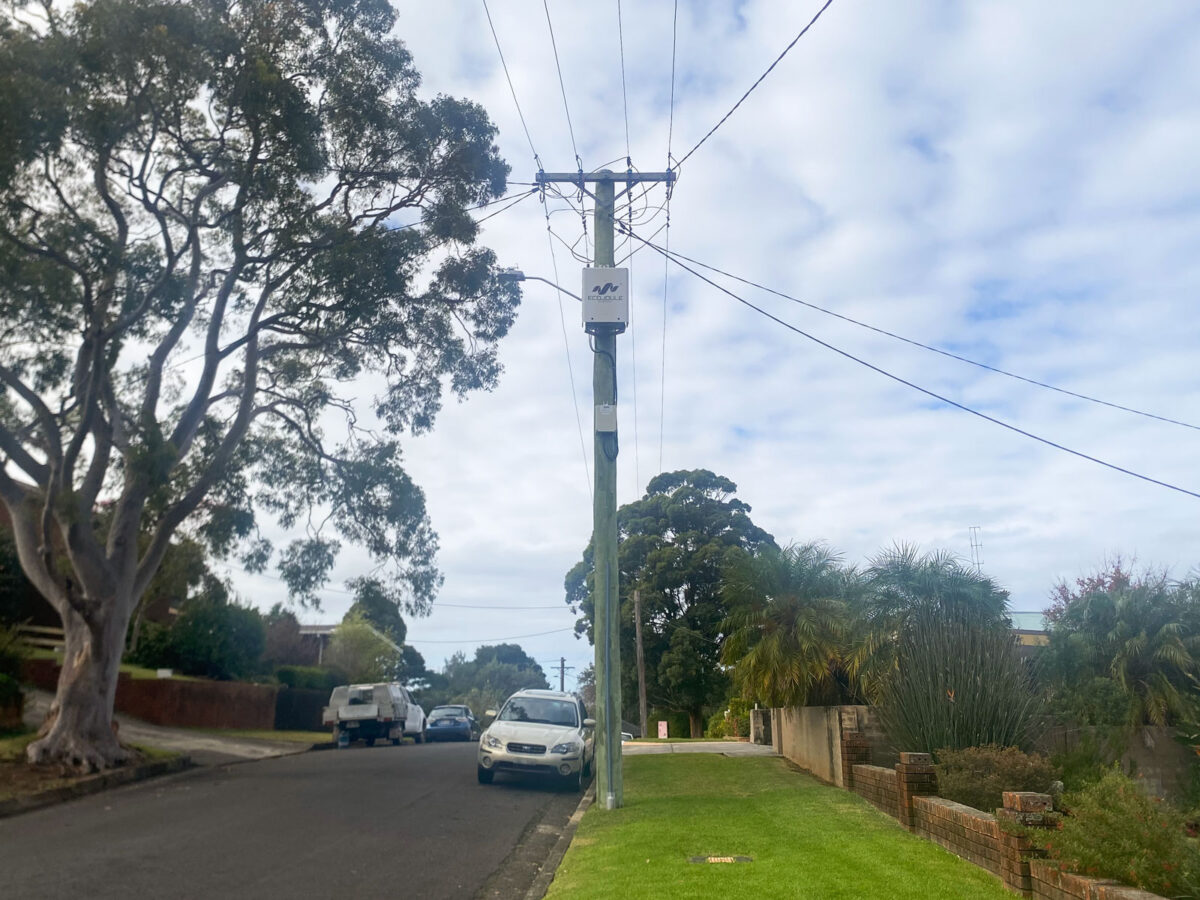
We are often asked what an EcoVAR does when it loses one or more phases of supply, and whether it can keep a de-energised line alive. It cannot.
The EcoVAR has no battery. It is three single-phase STATCOMs, one per phase, sharing a DC bus. That bus is a capacitor bank charged from the grid. It lets the EcoVAR move power between phases and supply reactive power, but it is not an energy source.
If any phase is lost, the EcoVAR stops compensating on all three phases and opens its grid relays. While the other phases stay energised, the controller remains on, so the event is logged and the unit can still be reached remotely. If all phases are lost, the unit powers down. Once supply returns and has been stable for the set reconnection delay, the unit reconnects automatically.
Short sags from motor and heat pump starts are handled differently. The EcoVAR injects maximum capacitive reactive power within 10 ms of phase voltage falling below 180 V, and holds this for up to 4 seconds by default. If the sag lasts longer, the unit trips and disconnects as it would for a lost phase. Protection settings follow AS/NZS 4777.2:2020 by default and can be changed for other standards. The rest of this bulletin sets out the detail.
Architecture
The EcoVAR converts 230 V phase-to-neutral AC to about 800 V DC on a capacitor bus shared by the three phase converters. The shared bus is what allows active phase balancing: power drawn from a lightly loaded phase is delivered to a heavily loaded one. Net active power exchange with the network is limited to conversion losses. The capacitors hold enough energy to control current, not to supply load.
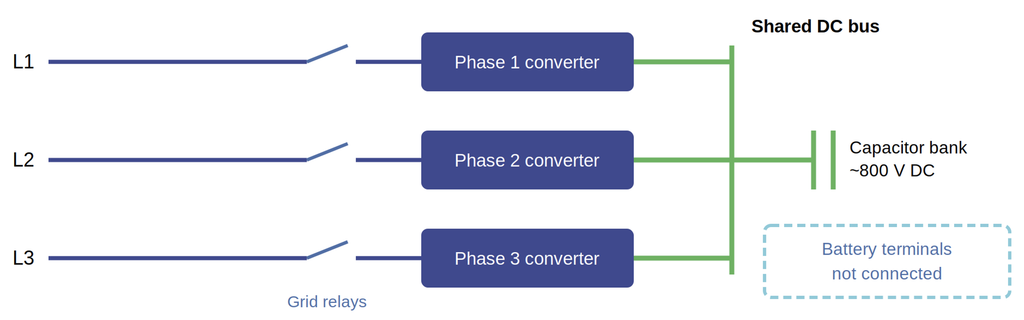
Figure 1. EcoVAR power architecture. Three phase-to-neutral converters share one DC bus (neutral omitted for simplicity). Battery terminals are fitted for a future EcoSTORE upgrade and are unused in a standalone EcoVAR.
The EcoVAR is sometimes confused with the EcoSTORE, which adds battery storage to the same inverter platform. A standalone EcoVAR has no battery connected.
Operating states
| State | Grid relays | Controller | Compensating | Typical trigger |
| Running | Closed | On | Yes | Normal operation: voltage regulation, phase balancing, harmonic filtering |
| Standby | Closed | On | No (IGBTs off) | Ready to operate, or compensation disabled |
| Waiting | Open | On while any phase is energised | No | After a trip or grid disturbance, until reconnection conditions are met |
| Powered down | Isolated by breaker or fuse | Off | No | Manual isolation, or loss of all phases |
Whenever the controller is powered, the unit logs data and can be configured and interrogated remotely through EcoFLEET, which displays these state names.
Sag ride-through
A fast-acting control loop (10 ms time constant) overrides the slower Volt-VAR droop control (5 s time constant). When phase voltage falls below the sag threshold, that phase injects maximum capacitive reactive power to reduce the depth of the dip. This covers common sags from motor starts, heat pumps and air-conditioner compressors.
| Parameter | Default | Range |
| Voltage sag/swell mitigation | Disabled | On / Off |
| Sag threshold | 180 V | 150–230 V |
| Undervoltage delay (maximum capacitive injection) | 2 s | 0–4 s |
| Swell threshold | 265 V | 230–265 V |
| Overvoltage delay (maximum inductive absorption) | 1 s | 0–2 s |
If the sag clears within the delay, the unit carries on. If it persists, the unit trips and moves to Waiting.
Loss of one or two phases
A lost phase is detected as a sustained undervoltage on that phase:
- Below 70 V: immediate trip and disconnection.
- Held between 70 V and 180 V, for example by downstream load or PV on an open conductor: trip after the undervoltage delay.
- Unintentional island: the frequency-shift active anti-islanding function disconnects the unit within 2 seconds.
Why the whole unit trips, not just the lost phase.
Firstly, inverter grid connection standards like AS/NZS 4777.2 mandate that all phases should trip when any one phase is lost. Although it is debateable whether PV inverter and BESS standards like AS/NZS 4777.2 are directly applicable to a STATCOM like the EcoVAR, these grid connection standards have become an industry norm, so EcoJoule has ensured compliance with them. Secondly, from a technical viewpoint active phase balancing uses all three phases together. If the two healthy phases kept running, the balancing control would draw power from them through the DC bus to try to hold up the dead phase. That would load the healthy phases and could energise the lost one. Tripping all three phases prevents both.
In Waiting, the relays are open and the unit does not inject onto any phase. The controller stays powered from the healthy phases, so the event is recorded and can be reviewed remotely.
Loss of all phases
With no supply, the controller loses power and the unit shuts down. The EcoVAR has no stored energy source and cannot energise the network.
Default protection limits
| Protective function | Limit | Trip delay | Maximum disconnection time |
| Undervoltage 2 (V<<) | 70 V | 1 s | 2 s |
| Undervoltage 1 (V<) | 180 V | 10 s | 11 s |
| Overvoltage 1 (V>) | 265 V | 1 s | 2 s |
| Overvoltage 2 (V>>) | 275 V | – | 0.2 s |
| Under frequency (F<) | 47 Hz | 1 s | 2 s |
| Over frequency (F>) | 52 Hz | – | 0.2 s |
AS/NZS 4777.2:2020 Tables 4.1 and 4.2 (Australia A). Alternative settings, for example to IEEE 1547 or EN 50549, are available on request.
If a voltage excursion clears before the trip time, the unit returns to its previous operating point within 400 ms of voltage recovering.
Reconnection
After a trip, the unit reconnects automatically once voltage and frequency have stayed within limits for the grid connection delay. Range: 5–360 s.
For field crews
The EcoVAR is not a generation source and cannot backfeed an isolated line. Inside the enclosure, the DC link capacitors can potentially hold lethal voltage for up to 10 minutes after power-down. Treat the unit as live until it has been metered.
ABOUT ECOJOULE ENERGY
EcoJoule Energy designs and manufactures low-voltage grid-edge power electronics in Brisbane, Australia. Its EcoVAR LV D-STATCOM is in field service with distribution utilities in Australia and internationally, and is available in pole-mount (EcoVAR Alto) and ground-mount (EcoVAR Terra) variants. EcoJoule’s technology relieves grid congestion and increases network hosting capacity, allowing the benefits of the energy transition to reach more users of the existing distribution network.