
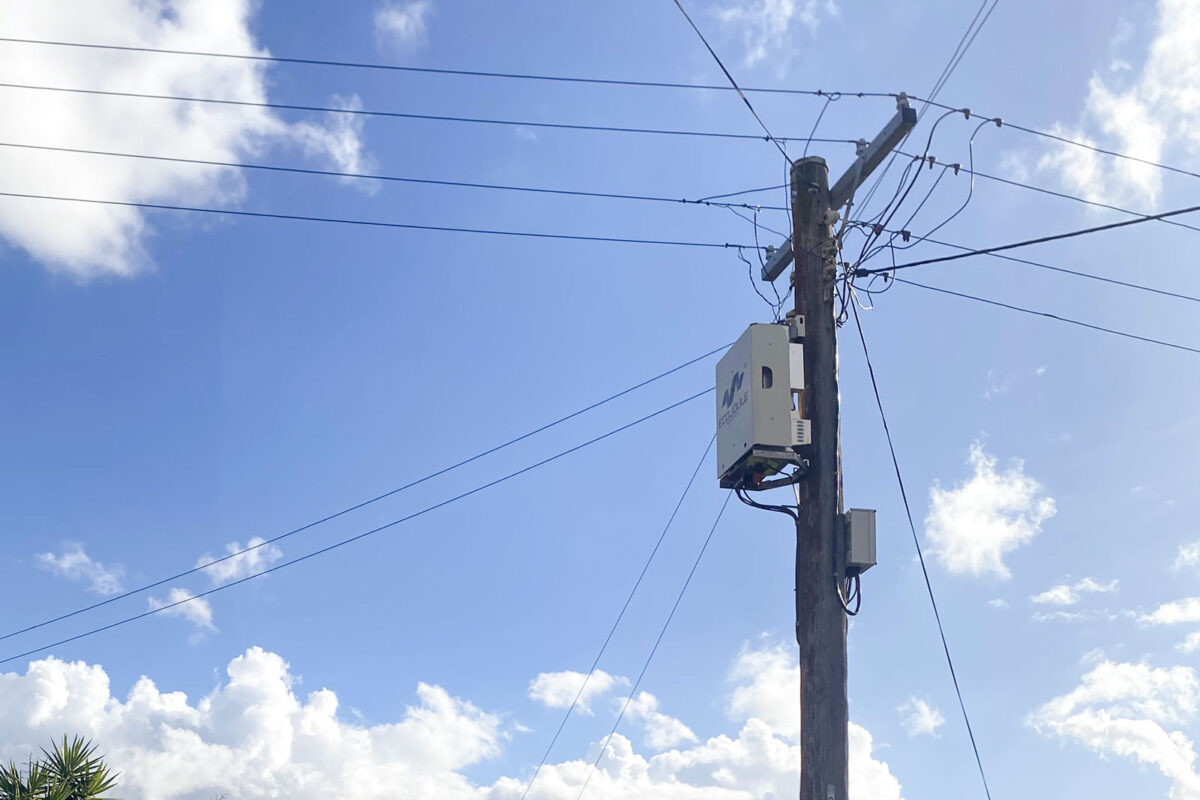
A D-STATCOM (Distribution LV STATCOM) and a feeder augmentation can both bring an LV feeder back inside voltage limits. They differ in how much engineering, land access and switching work sits between identifying the problem and the network being compliant. Four reasons the D-STATCOM path is shorter.
1. A D-STATCOM uses the existing poles and wires
An augmentation project changes the network’s physical assets. That means a feeder civil design: pole loading and strength assessment, conductor selection, clearance checks, possible easement or land acquisition for a new substation site, and design approval before any works order issues.
A D-STATCOM changes the network’s electrical behaviour without changing its topology. The EcoVAR Alto mounts on an existing pole; the EcoVAR Terra sits on a pad. Both connect to the existing LV mains. No conductor replacement, no new feeder route, no land acquisition. The civil design and land access critical path is removed, not shortened.
2. D-STATCOMs connect in parallel, not in series
A series device sits in the supply path. Installing it requires an LV outage, customer notification and a switching programme, and once installed it becomes a single point of failure between the transformer and the customer.
A D-STATCOM connects in parallel through its own protection. Consequences for delivery:
- Installation is a live connection — no planned outage, no notification process, no switching programme.
- An internal device fault operates the device’s protection and disconnects the unit. Supply to customers is unaffected; the network returns to its pre-installation condition.
- No new customer-interruption failure mode is introduced into the supply path, so the reliability case is straightforward.
3. One construction design per LV line type, used network-wide
The D-STATCOM installation is feeder-agnostic. The arrangement depends on the line construction, not on the feeder’s loading, length or fault level.
In practice, standards teams develop one standard arrangement per LV construction type in their network — bare conductor, aerial bundled conductor, underground pad-mount — and then apply it everywhere. Design effort becomes a one-off standards exercise rather than a per-project one. Once the standard arrangement exists, each subsequent site is a works order, not a design job.
4. The settings are generally common to every site but can be easily modified if required
The EcoVAR combines two control systems in one unit:
- Volt-VAR reactive control for voltage regulation and power factor.
- Simultaneous active power balancing control (patented) that transfers real power between phases to correct imbalance and neutral current.
Both controls act in closed loop on conditions measured at the point of connection. They are generally not tuned to a modelled feeder, so the setting file does not change site to site. One approved setting file covers the network. On occasions, for unusual sites (eg. Excessively weak low voltage feeders) the settings can be easily remotely modified.
That has direct operational consequences: spares are interchangeable across the fleet, a hot swap needs no re-engineering, and a crew can redeploy a unit from one site to another without a new study.
The net effect
The first D-STATCOM deployment carries the standards work: one arrangement per line type, one approved setting file. Every deployment after that is procurement plus a works order. Augmentation repeats the design, approval and outage cycle at every site.
Next step: EcoJoule can provide sample GA drawings for EcoVAR D-STATCOM installations, together with standard configuration for the Volt-VAR Droop curve. Contact EcoJoule for more information.