
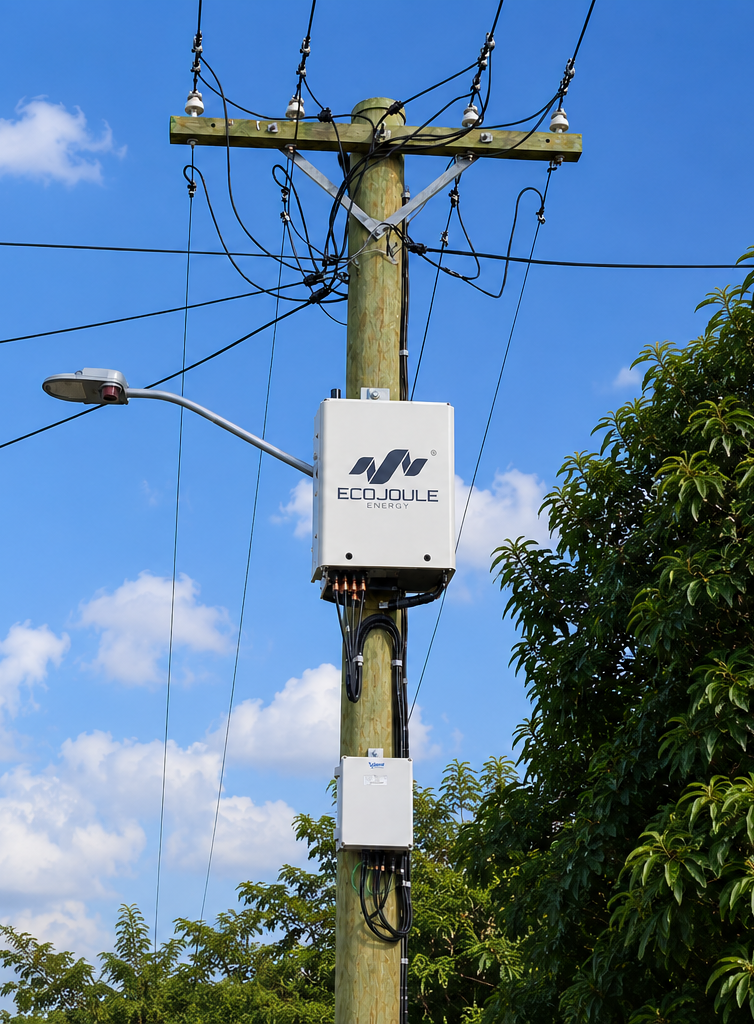
Australia’s low-voltage networks are facing growing pressure from rooftop solar, EVs and changing patterns of electricity demand. For network engineers, managing the resulting voltage and power-quality issues has traditionally required costly and time-consuming network augmentation.
EcoJoule Energy’s EcoVAR D-STATCOM provides an alternative. Installed directly on the LV network, EcoVAR uses advanced power electronics to dynamically manage voltage, reactive power and phase imbalance without major infrastructure upgrades.
It does not replace augmentation where additional network capacity is required. Instead, EcoVAR gives engineers a faster, flexible and deployable option for addressing common LV constraints, improving network performance and potentially deferring capital expenditure.
Six problems now account for the majority of LV feeder complaints and constraint reports. The EcoVAR addresses all six from a single pole-mounted unit.
| Problem | Typical cause on the LV feeder | EcoVAR response |
| Overvoltage | Reverse power flow from rooftop PV raising feeder voltage above the statutory limit, worst at the feeder extremities in the middle of the day. | Absorbs reactive power and rebalances phase loading to reduce voltage at the point of connection. |
| Undervoltage | Coincident evening demand from EV charging, heat pumps and air conditioning at the end of long feeders. | Injects reactive power and transfers real load between phases to raise voltage. |
| Voltage unbalance | Single-phase PV, EV chargers and heat pumps connected unevenly across the three phases. | Actively transfers real power between phases, reducing unbalance, peak phase current, neutral current and feeder losses. |
| Voltage sags | Step changes in LV load such as motor starting, welding plant and DC fast charging. | Sub-cycle detection and response limits the depth and duration of sags originating on the LV network. Sags originating from upstream HV faults are outside its scope. |
| Harmonics | Rectifier front ends in PV inverters, EV chargers, variable speed drives and switched-mode power supplies. | Active harmonic filtering injects counter-phase current on selected harmonic orders. |
| Flicker | Fluctuating load and rapidly varying generation on high-impedance and SWER-fed networks. | Continuous dynamic response holds voltage through the fluctuation, reducing Pst and Plt. |
Why the excursions matter
| Consequence | Why it drives action |
| Regulatory compliance and licence risk | Steady-state voltage limits are a statutory or licence obligation. Sustained excursions are reportable non-compliance, and the duty to correct sits with the distributor regardless of which connection caused it. |
| Customer complaints and cost to serve | Each excursion generates complaints, site visits and repeat investigation on the same feeder until the cause is found. Complaint volume is itself a reported performance measure. |
| Equipment that will not operate | Voltage outside the operating window causes EV chargers to derate or stop, PV inverters to trip and lose customer generation, and sensitive electronics to fail. As electrification scales, a charger that will not deliver is read by the customer as a network failure. |
Why these problems are growing
The LV network was designed to deliver diversified, unidirectional power to loads of a few kilowatts each. Four changes have invalidated that design basis, and all four act on the same conductors:
| Change | Effect on the LV network |
| Gas heating to heat pumps | Adds several kilowatts of coincident winter evening load per premises. |
| EV charging | Adds 7 to 22 kW single-phase point loads with high coincidence after work hours. |
| Rooftop PV | Reverses power flow for part of the day and raises voltage at the feeder extremities. |
| High power electronics | Injects harmonic current and concentrates load unevenly across phases. |
The network was never built for bidirectional flow at these power levels, and rebuilding it to suit is not economically feasible at the scale or pace the transition requires.
The traditional answer: augmentation
Augmentation resolves the constraint by reducing feeder impedance or adding capacity. It works, and it carries a fixed set of costs on every project:
| Cost driver | What it means in practice |
| Bespoke engineering | Site-specific design, load flow study and construction package for each location. |
| Approvals and access | Easements, consent, traffic management and environmental approvals. |
| Lead time | Design to energisation typically measured in months, against constraints that are emerging in weeks. |
| Customer outage | Planned interruptions to complete the work, with the associated notification and reliability impact. |
| Stranding risk | Capital committed to one location for the life of the asset, whether or not the constraint stays there. |
What the EcoVAR does differently
The EcoVAR is a low voltage D-STATCOM. It differs from a conventional STATCOM in one respect that matters on LV feeders: it combines Volt-VAR reactive control with active phase balancing.
LV feeders are resistance-dominated. A conventional STATCOM controls voltage by exchanging reactive power, which acts on the reactive component of line impedance. On a feeder with a high R/X ratio that lever is limited, which is why reactive-only compensation is often ruled out for LV voltage correction.
The EcoVAR also transfers real power between phases through its 864 VDC secondary bus, acting on the resistive component. The two mechanisms together give the EcoVAR voltage authority on feeders where reactive compensation alone would not be sufficient, without reconductoring.
Installation and deployment
| Attribute | EcoVAR |
| Installation time | Under two hours on a single existing pole. |
| Outage required | None. The unit is connected live to the LV network. |
| Engineering per site | None. No bespoke design package, no reconductoring. |
| Redeployment | The unit can be relocated when the constraint moves, so capital is not stranded. |
The cost comparison
EcoJoule compares options on an equivalent annual cost (EAC) basis, which normalises assets with different capital costs and different lives. On that basis, modelling across a range of network cases shows the EcoVAR annualised cost is generally one third or less of the augmentation option that resolves the same constraint, driven by lower installed capital and the ability to redeploy the asset. The result is more constraint resolved per dollar of capital budget, and a lower cost outcome for the customers who pay for the network.
EAC outcomes depend on the augmentation scope being displaced, the discount rate and the asset lives assumed. EcoJoule can run the comparison against your own assumptions.
Where augmentation is still required
The EcoVAR does not add conductor or transformer rating. That matters less in practice than it first appears, because of how LV constraints actually present:
| Constraint | Role of the EcoVAR |
| Genuine thermal limit on a balanced feeder | Augmentation is required. The EcoVAR restores voltage compliance within two hours while the augmentation project moves through the backlog, then redeploys to the next site once the works are energised. |
Deferral economics
Because the unit is redeployable, it does not have to displace an augmentation project to earn its return. It only has to delay it. EcoJoule’s modelling indicates a deferral of approximately two years is sufficient for the EcoVAR to return its cost across most network cases. Where the augmentation backlog already exceeds twelve months, that threshold is largely met by the queue alone.
| Where voltage non-compliance is already occurring and the augmentation project is a year or more from energisation, the alternative to the EcoVAR is not a faster upgrade. It is another year of non-compliance. |
Request the comparison for your network
The EAC cost comparison model and supporting application notes are available on request.
sales@ecojoule.com