
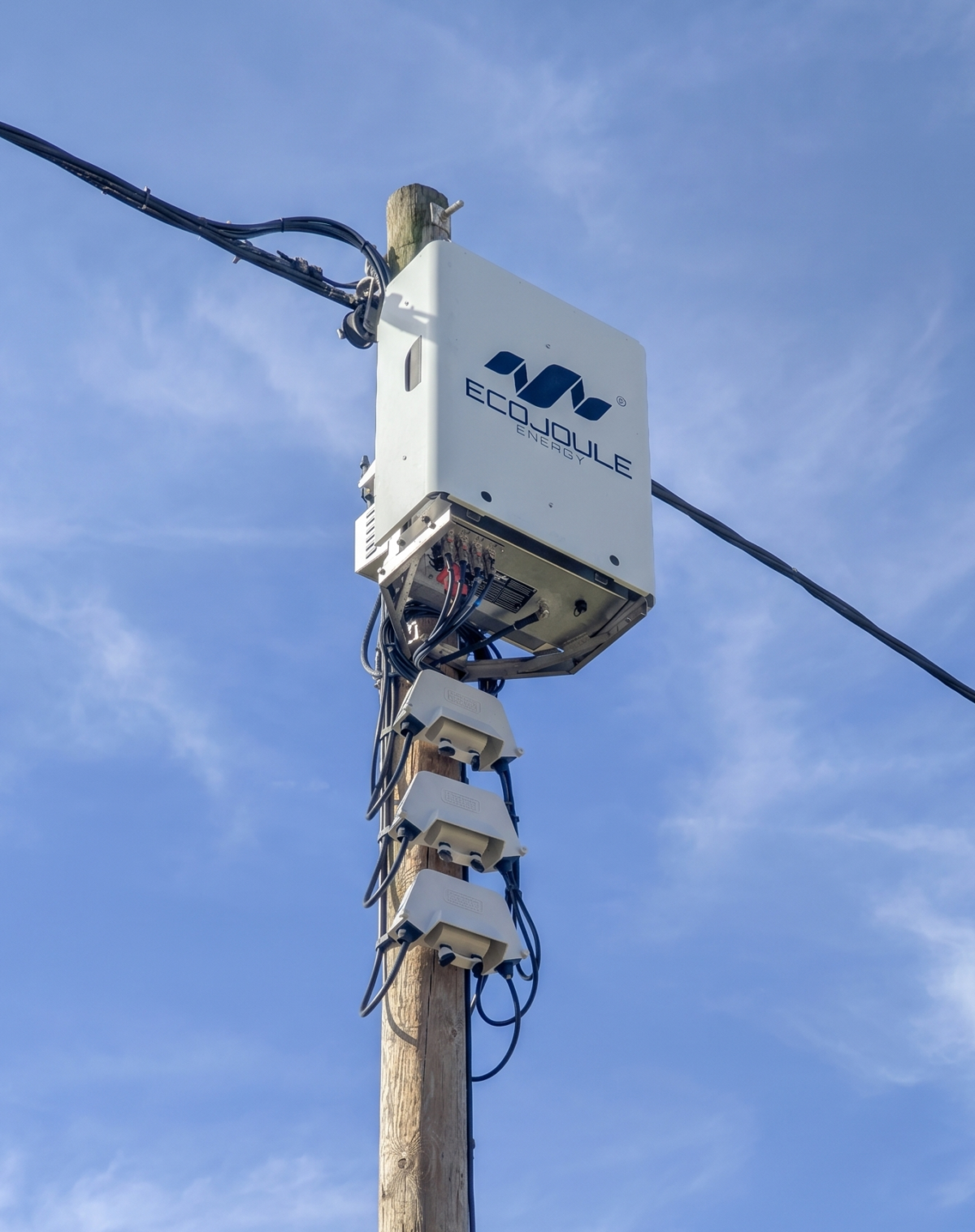
EcoJoule’s EcoVAR regulates voltage in parallel — sized below feeder current, installed without an outage, and responding within a single cycle.
As rooftop solar, batteries and electric vehicles push low-voltage networks beyond the conditions they were designed for, distribution businesses are re-examining how they manage voltage.
These distribution businesses are increasingly turning to low-voltage distribution STATCOMs (D-STATCOMs), like EcoJoule Energy’s EcoVAR, to address constraints that are inherent to traditional series voltage regulators, and do so without taking feeders out of service to install.
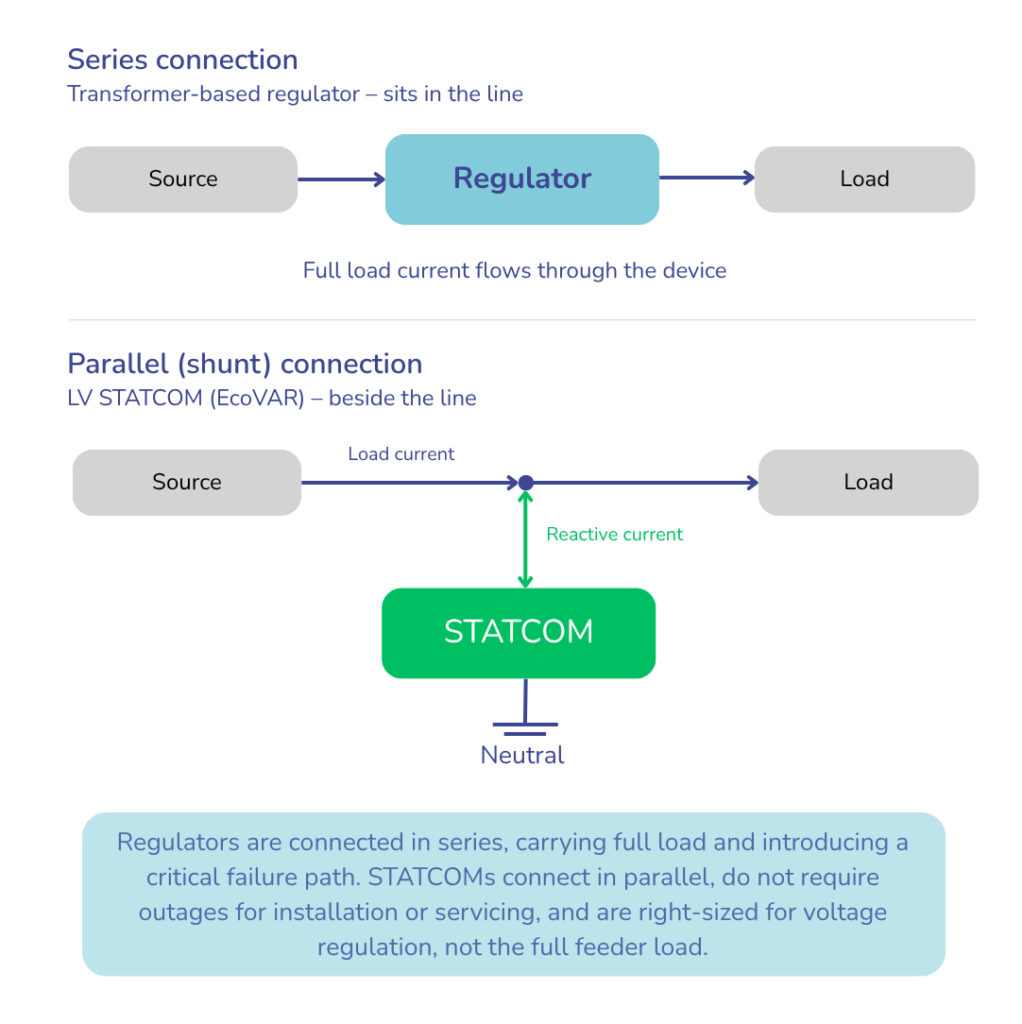
Traditional voltage regulators are connected in series with the feeder. The whole feeder current passes through the device, which sets its rating, size and the work required to install it. A STATCOM takes a different approach: it connects in parallel. The feeder current flows past the unit, and only the corrective current flows through it.
How a STATCOM differs from a traditional voltage regulator
- Parallel connection, not series. A series regulator carries the full feeder current. The EcoVAR connects in parallel, so feeder current flows past it and only the corrective current flows through the unit.
- Rated below feeder current, so smaller. Because it carries only the corrective current, a STATCOM can be rated for a fraction of the feeder current it supports. The result is a compact unit that suits an existing pole or enclosure.
- Installed without an outage. The parallel connection means the EcoVAR can be added to a live feeder and commissioned in hours, without the planned supply interruption a series device requires.
- Sub-cycle response. Power-electronic switching corrects voltage within a single cycle — a response far faster than the step changes of mechanical tap-changing regulators.
- Corrects imbalance between phases. A regulator that moves all three phases together cannot fix a feeder where some phases sit above the target voltage and others below — stepping the high phase down drags the low phases further down. The EcoVAR regulates each phase independently and shifts load between phases, bringing all three within limits at once and releasing feeder capacity for more solar.
- Holds its reference under two-way power flow. Traditional regulators reference the “line side voltage” for regulation. When rooftop solar exports and power flows back up the feeder, that reference is lost and the regulator can step the wrong way. A STATCOM sits in parallel, measures the local voltage directly, and injects or absorbs reactive power to hold it, so two-way flow does not disorient it.
- Active harmonic filtering too. Alongside voltage support and phase balancing, the EcoVAR filters harmonics, helping maintain power quality as more inverters and electronic loads connect.
“The network problems behind voltage limits and curtailed solar are real, and they need a device-based fix.
The question for distributors is which fix. A parallel STATCOM does the same regulation work without carrying the feeder load,
without an outage to install, and fast enough to follow conditions in real time.”
Dr Mike Wishart, Chief Executive Officer, EcoJoule Energy
In service across six markets
EcoVAR units are in service addressing voltage problems in the United Kingdom, Belgium, Lithuania, Australia, Malaysia and New Zealand.
In the United Kingdom, UK Power Networks is operating the EcoVAR on its network through an innovation project, with pole-mounted units installed in Kent. Details are published by UK Power Networks at ukpowernetworks.co.uk.
About EcoJoule Energy
EcoJoule Energy is an Australian energy technology company, established in 2014 and based in Brisbane. It develops technologies for the future grid, including low-voltage distribution STATCOMs (EcoVAR) and battery energy storage systems. EcoJoule’s technology relieves grid congestion and allows solar generation to reach more customers, maximising the use of existing poles and wires so the benefits of the energy transition can flow to all users of the distribution grid.