
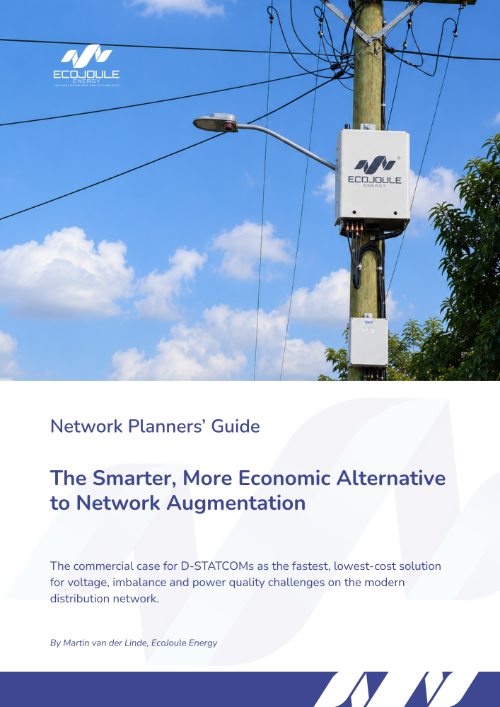
EcoJoule Energy’s Network Planners’ Guide explains how D-STATCOM technology provides network planners and engineers with a faster, more flexible and lower-cost alternative to conventional network augmentation, while improving voltage regulation, phase balance and power quality across increasingly complex distribution networks. Download the full guide here.
Executive Summary
Low-voltage electricity networks are under growing pressure from rooftop solar, electric vehicles, electrification and other distributed energy resources (DER), while much of the infrastructure supporting them was designed for a very different energy system.
The resulting overvoltage, undervoltage, phase imbalance, and power quality issues do not always indicate that a network has run out of capacity. Where the constraint is voltage or imbalance rather than thermal capacity, LV D-STATCOM technology such as EcoJoule Energy’s EcoVAR™ can provide a faster, more flexible alternative to traditional augmentation.
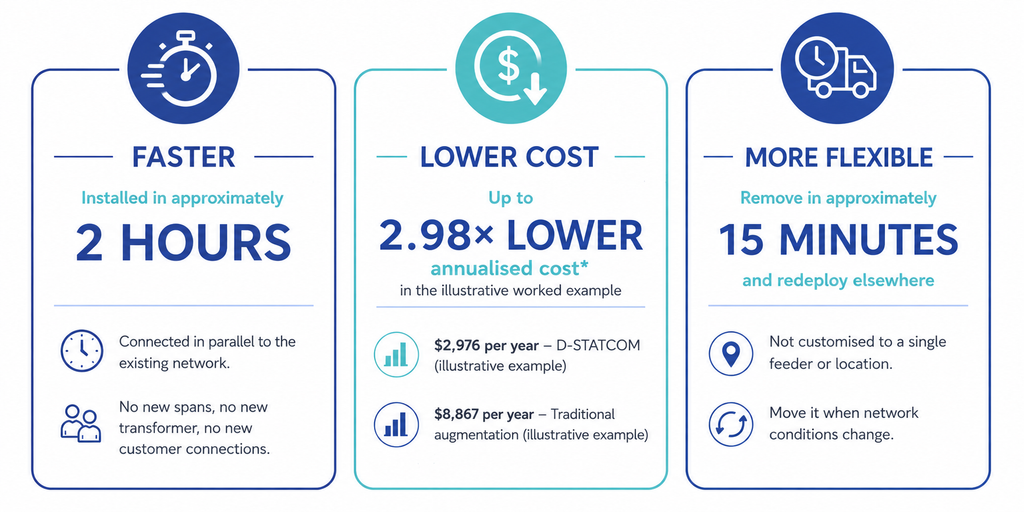
EcoVAR can be installed in approximately two hours with no customer outage, avoiding much of the engineering, construction and disruption associated with traditional network upgrades. In the illustrative example examined in this paper, the D-STATCOM solution delivers an annualised cost that is approximately 2.98 times lower than that of traditional augmentation. It can also defer major capital works and be redeployed as network requirements change.
The opportunity is not to replace augmentation where additional thermal capacity is genuinely required. It helps match investment to actual constraints, solve problems sooner, deploy capital more efficiently, and get more from existing network infrastructure.
D-STATCOM or Traditional Augmentation?
Traditional augmentation means reconducting LV lines, installing new transformers, or extending the medium-voltage supply to split feeders and shorten LV runs. Manual phase balancing, moving single-phase customer connections between phases, is also a form of augmentation.
A D-STATCOM is a form of augmentation. It requires no new HV line, no outage, and installation is under two hours. The engineering design is standard for all installations on a given network.
The limitation is explicit: a D-STATCOM does not add thermal capacity. Only augmentation does that.
Most voltage, imbalance and harmonic problems can be resolved without adding capacity. That is the selection test.
Three differences matter to a planner.
1. Speed – Connected in parallel to the existing network. No new spans, no new transformer, no new customer connections. Installed and commissioned in two hours. Augmentation projects run in days or weeks and include a customer outage.
2. Project Cost – The unit cost is comparable to that of a single transformer. The difference is the project around it: engineering design, outage management, traffic management, and construction lead time.
3. Redeployment – When capacity becomes the binding limit, an installed D-STATCOM can be moved. It is not customised to a site. Removal takes 15 minutes, and reinstallation takes two hours. Augmentation is fixed to the site where it is built.
Where a D-STATCOM Applies
A D-STATCOM, such as EcoJoule Energy’s EcoVAR, connects in parallel with the existing LV network and directly addresses voltage imbalance and harmonic problems. The technology is particularly applicable where the network is experiencing:
- Overvoltage – Often associated with high levels of rooftop PV exporting onto an LV feeder.
- Phase imbalance – Created when load and generation are unevenly distributed across the three phases.
- Harmonics – Increasingly relevant as inverter-based and power-electronic devices proliferate.
- Undervoltage on one or two phases – Where available capacity exists elsewhere across the three-phase network.
- Voltage sags, swells and flicker – Where dynamic voltage support can improve local power quality.
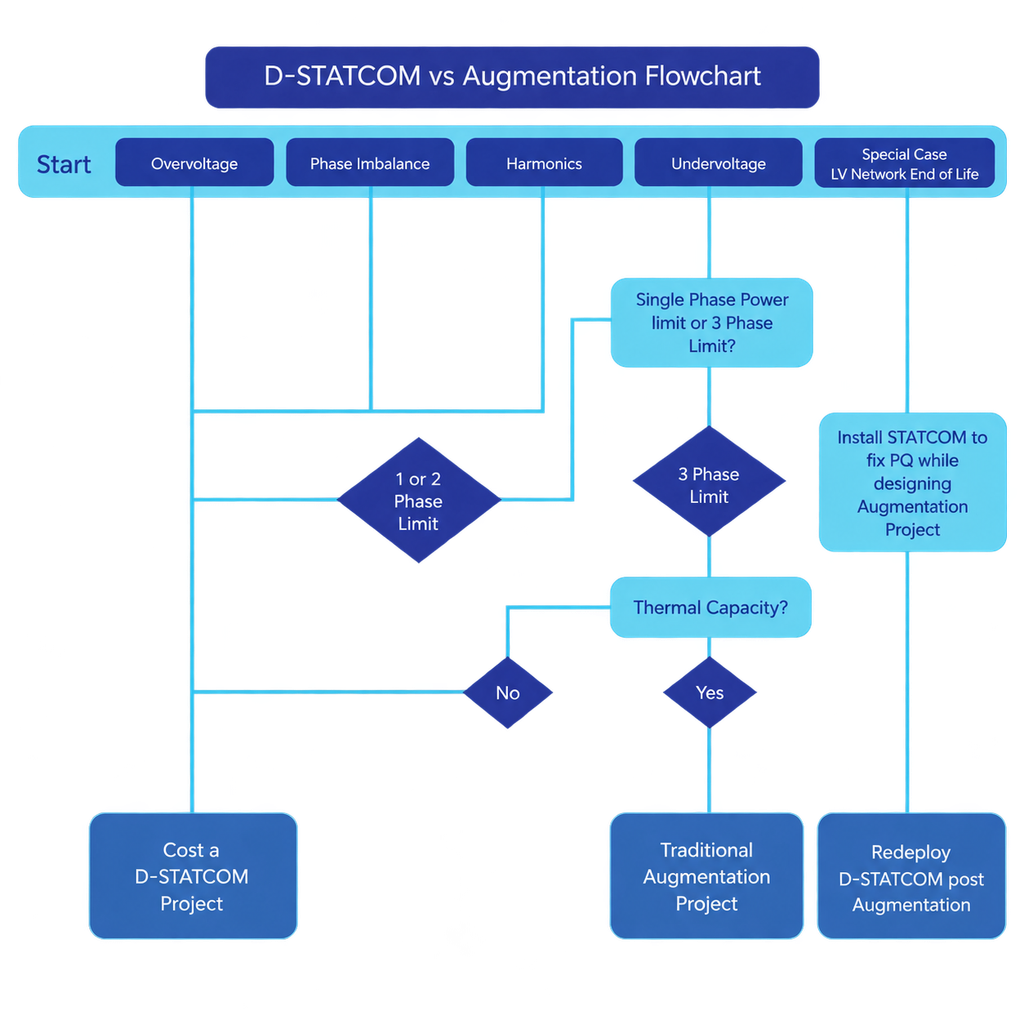
Selection Guide
| Observed problem | Outcome | Reason |
|---|---|---|
| Overvoltage | Cost a D-STATCOM project | Active power is not the limit, so the device always has authority. |
| Phase imbalance | Cost a D-STATCOM project | At least one phase carries excess active power. Active phase transfer corrects it. |
| Harmonics | Cost a D-STATCOM project | Harmonic correction is not limited by active power. |
| Undervoltage on one or two phases | Cost a D-STATCOM project | A single-phase power limit. Correctable by transfer between phases. |
| Undervoltage on all three phases | Traditional augmentation project | A thermal capacity limit. A D-STATCOM does not add capacity. |
| LV network at end of life | Both, in sequence | Install the D-STATCOM to hold power quality while the augmentation is designed, then redeploy it. |
Calculating the Benefits
The real cost of solving an LV network constraint extends well beyond the upfront price of the equipment.
Traditional augmentation may deliver infrastructure with an asset life measured in decades, while a D-STATCOM has a shorter life but offers something conventional infrastructure cannot: the flexibility to be removed and redeployed as network needs change.
A simple capital-cost comparison therefore does not compare like with like. A more meaningful approach is to compare the cost of delivering the required network outcome over time.
Equivalent Annual Cost (EAC) provides that comparison by annualising each component according to its cost, expected asset life and discount rate:
EAC = C ÷ [(1 − (1 + r)^-n) ÷ r]
Each project component retains its own asset life, allowing long-life infrastructure, engineering, installation and equipment costs to be assessed consistently. This provides planners with a clearer picture of the long-term economics of each approach rather than focusing solely on initial capital expenditure.

The Value of Deferring Augmentation
The decision is not always D-STATCOM or traditional augmentation. Where additional thermal capacity will eventually be required, a D-STATCOM can address the immediate voltage or phase constraint while allowing major augmentation to occur when that additional capacity is actually needed.
Deferral can postpone significant capital expenditure, potentially move investment into a future regulatory period and provide more time to understand how DER penetration and demand will develop.
Importantly, the investment does not have to become stranded when augmentation eventually occurs. If the D-STATCOM still has useful service life, it can be redeployed to another constrained feeder, extending the value of the original investment.
The objective is not to avoid necessary augmentation. It is to solve today’s constraint efficiently, preserve future options and invest in permanent network capacity when the network actually needs it.
How a D-STATCOM Works
The D-STATCOM is a three-phase power electronic device connected to the LV network in parallel. It is three independently controlled inverter-STATCOMs, one per phase, with a common shared 864V nominal DC bus.
Two control actions run at the same time.
- Reactive Injection – The unit exchanges reactive current with the network at the point of connection. The voltage change is approximately: ΔV ≈ Q·X / V, where Q is the injected reactive power, X is the upstream reactance and V is the nominal voltage. The unit works against upstream impedance. More upstream reactance gives more voltage authority.
- Active Phase Transfer – The unit moves real power between phases through a shared DC bus. This corrects imbalance directly rather than compensating negative sequence current alone. Active harmonic filtering runs on the same hardware, injecting harmonic current in antiphase.
Expected Voltage Correction
Worked case: 95 mm² aluminium overhead conductor, R ≈ 0.32 Ω/km, X ≈ 0.29 Ω/km, X/R ≈ 1, 1 MVA distribution transformer, 40 kVAr device.
| Distance from transformer | Voltage correction | As percentage |
|---|---|---|
| 500 m | ≈ 16 V | 4.00% |
| 750 m | ≈ 22.5 V | 5.60% |
Transformer rating has little effect at the feeder end. At 750 m, line reactance is about 95% of total upstream reactance, so a 500 kVA and a 1 MVA transformer give nearly the same result.
Two limits apply. Reactive injection does not correct voltage drop caused by real load current through line resistance. On an underground cable, X/R is lower and correction per kVAr is lower than the figures above.
D-STATCOMs still work in both cases, but the total voltage change per unit may be lower. Multiple STATCOMs can be connected to the same LV network to increase power if necessary. It is rare, even on aerial bundled conductor (ABC) networks, to need more than one 40 kVAr unit per LV feeder.
Site Selection
Place the unit near the voltage or imbalance problem. Most installations fall between 50% and 80% of the way along the LV feeder, but that range is a guide rather than a rule. Position follows the problem.
Move toward 50% where PV generation is concentrated in the middle of the feeder, or where the LV line can be backfed. Move toward the far end where the deviation is worst at the end. A shift of a few spans either direction makes no material difference to the result.
Within that zone, select the cheapest site to build. Where the electrically preferred pole carries streetlighting, fuses or telecommunications equipment, or where vegetation restricts access, move to the next clean pole. Installation cost dominates the difference; electrical position does not.
Where smart meter data is available, use it to identify the spans and phases with the most frequent and most severe deviations. This reduces selection to a short list of candidate poles.
Voltage is held closest to setpoint at the point of connection, but the effect is seen along the whole feeder.
A head-end tap changer translates the entire profile: it can be set for midday or for evening, not both. A D-STATCOM at the constrained node holds that node at setpoint and reverses between absorbing and injecting as conditions change.
Connecting a D-STATCOM to the Network
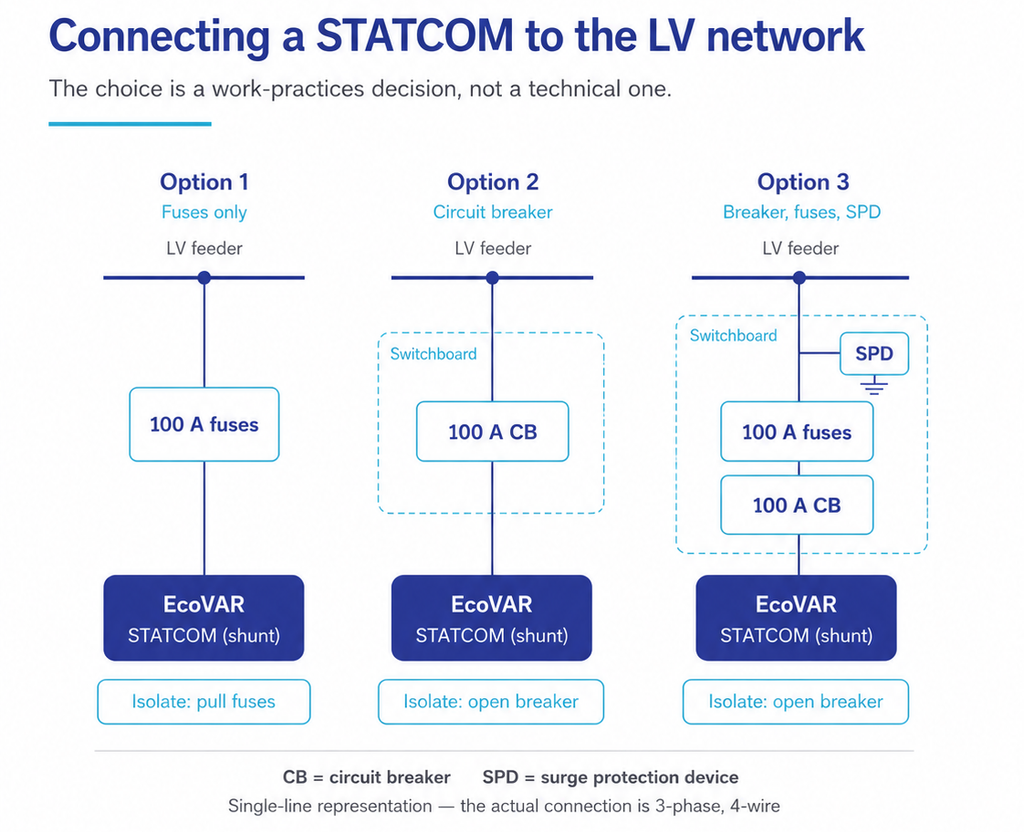
The unit connects in shunt. The feeder continues to carry its load and does not need to be de-energised to connect or remove the unit. There is no customer outage.
Every shunt connection needs overcurrent protection and a means of isolation. Three arrangements are used. All three perform identically. The choice is a work practices decision, not a technical one.
| Arrangement | Isolation method | When it is used |
|---|---|---|
| Outdoor fuses | Pull the fuses | Lowest cost, fewest components. Not available where technicians may not pull live LV fuses. |
| Switchboard with circuit breaker | Open the breaker | Where live fuse pulling is prohibited by work practices. |
| Switchboard with breaker, backup fuses and SPD | Open the breaker | Where surge protection is required by network standard. |
Rating is 100 A, whether fuse or breaker. Rated current is 63.5 A continuous, with short-time capability of 1.5 × rated, approximately 95 A. Most off-the-shelf MCBs derate at elevated ambient temperature. At the unit’s 50°C maximum, a marginally sized breaker can trip at full output. A 100 A device holds margin above the derated threshold while remaining low enough to protect the connection. Confirm that the shunt connection conductors are rated to carry 100 A.
Notes for Protection Engineers
- The D-STATCOM is not an energy storage device. It sources power from the line side. Loss of phase or loss of supply removes it from the circuit.
- Onboard capacitors discharge over approximately one minute on loss of mains.
- The protective device on the overhead connection is 100 A, fuse or MCB, subject to work practices.
- Anti-islanding is handled by internal relays. Undervoltage and underfrequency disconnect settings are configurable and are shipped to IEC 62477 inverter settings.
- As a utility-grade device, the disconnect range is often widened on commissioning. This allows the unit to correct voltage during a sag rather than disconnecting, and to connect to a non-compliant voltage and then bring it into compliance.
- The tests highlighted in this white paper are intended to be run by the planner on network data and cost data that the planner controls.
- A D-STATCOM will not suit every site. Where the constraint is thermal, it does not apply. Where it does apply, the annualised cost comparison should be run and recorded either way.
For More Information
Martin van der Linde
Chief Commercial Officer
EcoJoule Energy Pty Ltd
sales@ecojoule.com