Distributed by Design: Why the EcoVAR Is a Utility-Scale Power Quality Solution

EcoJoule Energy’s EcoVAR Low Voltage D-STATCOM delivers utility-scale power quality outcomes from distributed installations — addressing voltage instability, phase imbalance, and harmonics at the point of cause, rather than attempting centralised correction downstream.

A common assumption in network planning is that system-scale problems require system-scale equipment. EcoJoule Energy’s EcoVAR challenges that assumption — and the evidence from operating deployments supports a different conclusion: distributed power quality correction, applied at the source of grid stress, is more effective, more cost-efficient, and more resilient than centralised approaches.

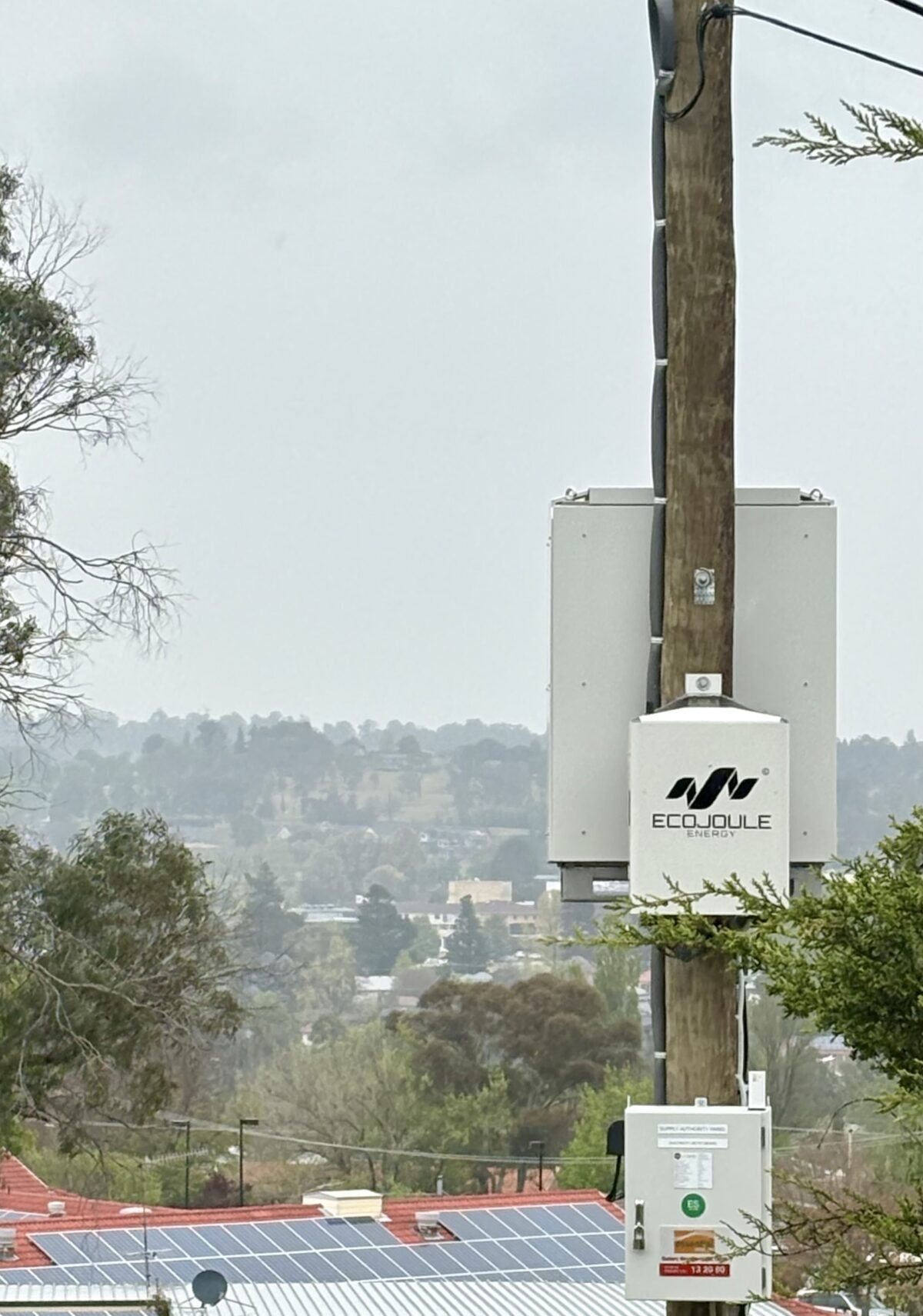
The EcoVAR is a Low Voltage Distribution STATCOM (D-STATCOM) installed on the LV distribution network by the utility. A single unit serves all customers downstream on a feeder segment, from typically 5 to 200 residential connections, or a combination of residential and commercial loads including three-phase commercial buildings.

The device is not a customer-premises solution. It is utility infrastructure, approved, owned, and operated by the network business.

Distribution networks are not uniform. Voltage instability, phase imbalance, and harmonic distortion each originate at specific points on the network. They are at the customer connection, at the inverter, at the motor load. Centralised solutions, whether at the substation or at transmission level, address these problems after the fact, working against the impedance of the network itself.

The physics favour distribution. Reactive power, which governs voltage stability, cannot be efficiently transported over long distances. Every kilovar of reactive support sourced locally avoids the losses associated with delivering that support from a remote point. An EcoVAR installed at the end of a feeder provides reactive compensation where the voltage drop is greatest, with no transmission losses and no dependency on upstream infrastructure capacity.

The same principle applies to harmonics. Distortion generated by inverter-based loads, variable speed drives, and EV chargers propagates upstream through the network. Filtering that distortion at or near the source, before it reaches the substation transformer, reduces impedance stress throughout the network. Centralised harmonic management addresses the symptom; distributed filtering addresses the cause.

The EcoVAR’s value is not derived from a single performance metric. Its business case is built by stacking measurable outcomes across the performance categories that regulators and utilities already track: voltage compliance, loss reduction, asset life, and capital deferral. Each benefit is independently quantifiable; together they produce a compelling investment case even at the individual feeder level.

Voltage Regulation Compliance

The EcoVAR provides continuous dynamic VAr compensation, maintaining voltage within statutory limits in real time. For feeders where voltage regulators are cycling rapidly due to embedded generation or variable loads, the EcoVAR reduces the regulation burden and measurably extends voltage regulator asset life. This is a directly quantifiable O&M saving.

Phase Imbalance and Neutral Loss Reduction

Single-phase residential loads create phase imbalance that causes neutral current, increased distribution losses, and thermal stress on LV transformers. The EcoVAR dynamically balances phases in real time, reducing losses and extending transformer service life. Distribution loss reduction is a directly reportable metric with measurable dollar value per MWh recovered.

Active Harmonic Filtering — Network-Wide

The EcoVAR includes active harmonic filtering, addressing IEEE 519 and equivalent harmonic compliance obligations at the feeder level. Rather than requiring individual commercial customers to install dedicated filter banks, a single EcoVAR manages harmonic distortion for all connected loads, all reducing administrative burden and providing more consistent network-wide compliance.

Three-Phase Commercial Load Quality

For feeders serving commercial and industrial customers with three-phase supply, voltage imbalance causes motor derating, increased copper losses, and equipment failure. The EcoVAR corrects three-phase voltage imbalance in real time, reducing customer complaints, improving reliability metrics, and extending the service life of customer and network equipment alike.

DER Integration and Capital Deferral

As rooftop solar penetration increases, overvoltage from reverse power flow becomes a feeder-level constraint that would otherwise require reconductoring or substation upgrades. The EcoVAR manages this dynamically, deferring or eliminating network augmentation expenditure. Avoided capital is the highest-value economic argument in a utility rate case or regulatory investment proposal.

The objection that distributed solutions cannot achieve system scale impacts misunderstands how distribution networks function, they are in fact distributed systems themselves. It makes intuitive sense that a distributed solution is the best solution for distribution networks.  A utility deploying EcoVARs across a portfolio of feeders achieves network-wide power quality improvement through coordinated distributed correction. This is the same principle that underpins modern distributed energy resource management. The EcoVAR is not a substitute for system planning; it is a tool that makes existing infrastructure more capable, deferring the need for system-level intervention.

Critically, each EcoVAR installation is independently valuable. The business case does not depend on network-wide deployment. A single unit on a constrained feeder delivers measurable, reportable outcomes from day one. Voltage compliance, loss reduction, asset life extension, all while the utility builds confidence in the technology before broader rollout.

This deployment model reduces investment risk significantly compared to large, centralised infrastructure projects, which require full commitment before any benefit is realised.

EcoJoule Energy designs and manufactures Low Voltage Distribution STATCOMs (EcoVAR) and Battery Energy Storage Systems (EcoSTORE) for electricity distribution networks worldwide. EcoJoule’s technology is deployed by utilities across Australia, Asia-Pacific, and Europe. The company’s mission is to ensure that the benefits of the energy transition reach all users of the distribution grid — by relieving grid congestion, enabling solar generation to reach more customers, and maximising the capacity of existing network infrastructure. EcoJoule is headquartered in Brisbane, Australia.

MEDIA ENQUIRIES

Martin van der Linde
Chief Commercial Officer
sales@ecojoule.com
EcoJoule Energy joins Electric Energy Society of Australia as Bronze Sponsor

Global operator of Distribution STATCOMs across four continents brings field-proven grid management expertise to the Australian engineering community.

EcoJoule Energy today announced it has joined the Electric Energy Society of Australia (EESA) as a Bronze Sponsor. The membership reflects EcoJoule’s commitment to contributing global operational experience in low voltage distribution management to Australian power engineers as the sector navigates the challenges of widespread distributed energy resource (DER) integration.

EcoJoule’s EcoVAR Distribution STATCOM is currently in service across four continents, making it one of the most operationally validated low voltage STATCOM platforms available to distribution network service providers worldwide. The company joins EESA at a time when Australian networks face mounting pressure from rooftop solar penetration, load imbalance, and power quality degradation across low voltage feeders.

A core principle guiding EcoJoule’s deployment approach is that Distribution STATCOMs are most effective when applied close to the point of voltage excursion — at the low voltage lines where solar generation, excess load, and power quality issues interact directly. This distinguishes the EcoVAR from upstream voltage management approaches, which address symptoms rather than causes and leave low voltage customers with limited relief.

The EcoVAR delivers simultaneous reactive power compensation, phase balancing, and active harmonic filtering in a single field device. Its 800 VDC secondary architecture and installation process that requires no network outage reduce deployment cost and customer disruption. These are both material considerations for networks managing increasingly tight maintenance windows.

EcoJoule positions the EcoVAR as the commercially demonstrated, field-proven alternative to network augmentation for managing the modern distribution environment. Augmentation carries a structural disadvantage that is widely understood but rarely quantified in investment decisions: the stochastic nature of network demand means new assets routinely enter service years ahead of their utilisation curve, creating capital that earns no return until load growth catches up. The EcoVAR allows networks to extract maximum capacity from existing infrastructure now, deferring augmentation expenditure until it is genuinely warranted — and in many cases avoiding it entirely.

The installed cost of EcoVAR deployment is a fraction of augmentation, and the device operates dynamically, responding to real-time network conditions rather than being sized for a future peak that may arrive later than modelled, or not at all. Through its EESA membership, EcoJoule intends to contribute to the Society’s technical program with content grounded in operational data from live network deployments, supporting Australian power engineers with practical, evidence-based guidance on low voltage STATCOM application as DER penetration continues to grow.

About EcoJoule Energy

EcoJoule Energy develops and deploys Low Voltage Distribution STATCOMs and Battery Energy Storage Systems for electricity distribution networks. The company’s EcoVAR platform is in service across four continents, enabling distribution network operators to manage voltage excursions, phase imbalance, and power quality issues at the low voltage level — maximising the capacity of existing network infrastructure and enabling greater solar generation to reach more customers. EcoJoule believes the energy transition should deliver benefits to all electricity users, and designs its technology to ensure the benefits of distributed generation flow equitably across the distribution grid.

Martin van der Linde 
Chief Commercial Officer
EcoJoule Energy
sales@ecojoule.com

Four reasons electrical engineers specify the EcoVAR D-STATCOM over traditional augmentation

As distributed solar generation and EV charging reshape load profiles hour by hour, static compensation and scheduled phase balancing can no longer keep pace. EcoJoule’s EcoVAR addresses the root cause: dynamically, continuously, and without taking feeders out of service.

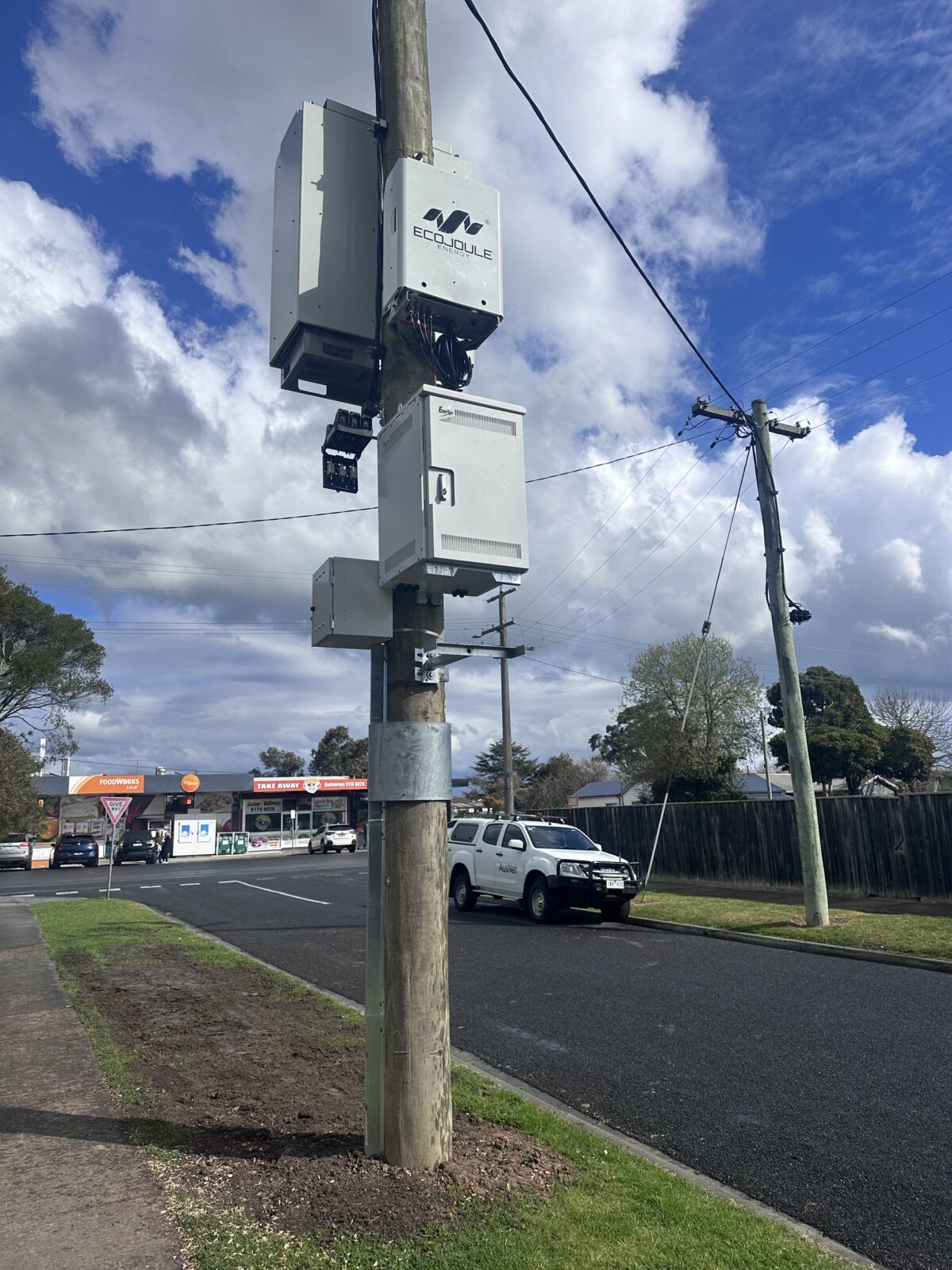
Distribution engineers across four continents are specifying EcoJoule’s EcoVAR low voltage D-STATCOM as the primary tool for managing congestion, voltage instability, phase imbalance, and harmonic pollution on LV networks. The EcoVAR is pole-mounted on existing overhead LV infrastructure. In form and installation footprint it closely resembles a conventional MV/LV distribution transformer, connected directly to each LV phase conductor. Four technical characteristics consistently drive specification decisions.

1. Maximise existing infrastructure: defer or eliminate capital augmentation

Traditional network congestion has a traditional answer: build more poles and wires. Overhead line augmentation typically costs an average of $560,954 per km, with some DNSP’s reporting over $1.5M AUD per km in submissions to the energy regulator. LV augmentation often requires easements, community consultation, and civil works measured in years, and delivers capacity that may be underutilised for the first decade of operation.

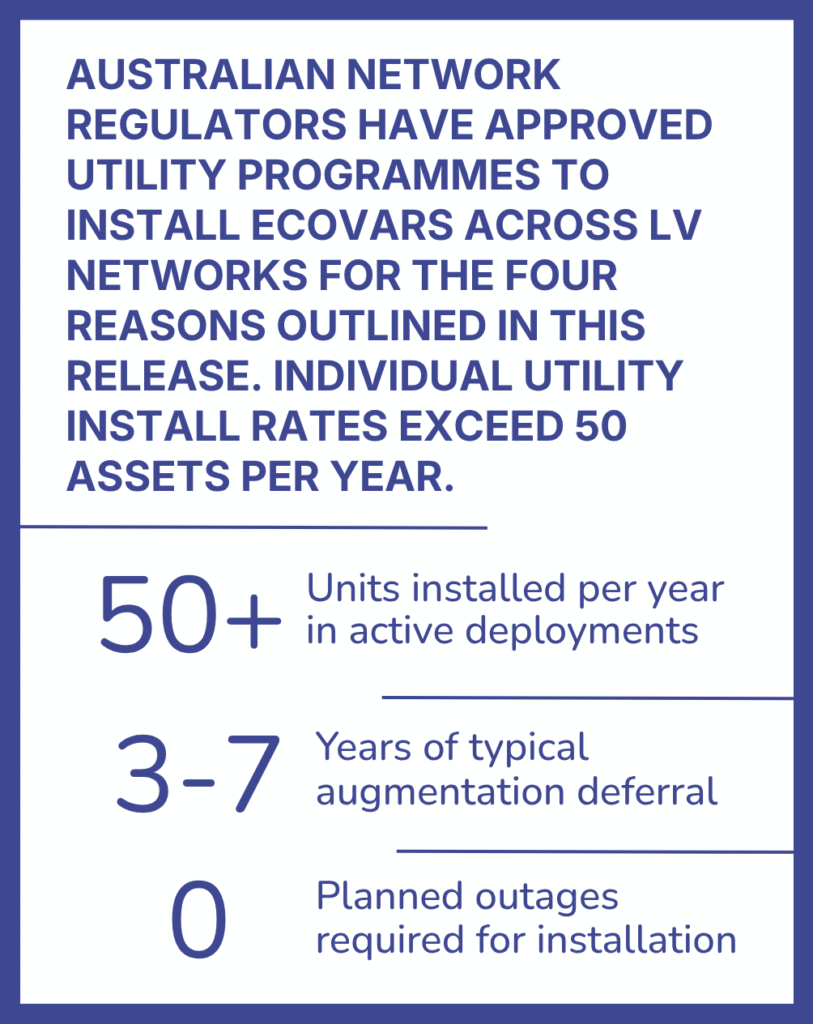
A single EcoVAR unit provides reactive power compensation, voltage regulation, and harmonic filtering from an existing pole position on the LV overhead network. By correcting power factor and reducing resistive losses in real time, it recovers usable capacity on conductors already in service. In documented deployments, a single installation has deferred line augmentation by three to seven years, with capital savings representing a substantial multiple of the device and installation cost.

Installation note: The EcoVAR’s 800 VDC secondary bus architecture enables connection directly to the LV overhead lines with no HV interruption, no planned outage, and no network access window required. Australian distribution utilities are commissioning EcoVAR units in a few hours, at a total installation cost of a few thousand AUD per unit.

2. Manage dynamic and bidirectional loads: rooftop solar and EV charging simultaneously

    The operating envelope that distribution equipment was designed for has changed. A residential feeder that once carried predictable morning and evening peaks now experiences reverse power flows during midday solar export, rapid load ramps as EV chargers cycle on and off, and voltage rise events that trip inverters and curtail generation. Static capacitor banks and fixed tap changers were not designed for this environment.

    The EcoVAR operates as a fully dynamic compensator, responding to network conditions in under one cycle. It absorbs or injects reactive power continuously, suppresses voltage swings caused by variable generation, and provides active harmonic filtering to address the harmonic currents introduced by inverter-based resources and EV chargers. The result is a feeder that can accommodate significantly higher penetration of distributed energy resources without voltage limit violations, increasing the volume of solar generation that reaches end customers through existing infrastructure.

    Network-level impact: Voltage rise on congested feeders is the primary technical constraint limiting rooftop solar connection approvals. An EcoVAR installation directly expands the connection capacity of the feeder, reducing deferred solar connections and improving returns on existing network assets.

    3. True dynamic phase balancing: manual rebalancing is no longer a viable maintenance strategy

    Phase balancing on LV overhead networks has historically been performed by a linesman crew travelling to the affected area, climbing poles, and physically disconnecting overhead line connections to individual properties before reconnecting them to a different phase. This is not a switchboard adjustment. It is live overhead work requiring traffic management, safety exclusion zones, and multiple crew members. A single rebalancing job across a suburban street can consume a full day of skilled labour and plant, at significant cost per intervention, before accounting for repeat visits as conditions change.

    This approach had a reasonable basis when load profiles were stable and predictable, and when a survey conducted on a Tuesday morning could be relied upon to reflect typical conditions. It no longer does. On a modern LV feeder, a household’s net phase contribution changes sign between 11am and 6pm as rooftop solar generation gives way to EV charging. The phase that appeared lightly loaded during the morning survey may be the most heavily loaded by the time the crew reaches the end of the street.

    Manual rebalancing performed against one set of conditions creates imbalance under another, and the cost of scheduling a return crew visit is non-trivial. Neutral current increases, transformer losses rise, and voltage deviation across phases widens, accelerating asset degradation and increasing energy costs for every customer on the feeder.

    The EcoVAR resolves this because each internal phase operates independently, referenced phase-to-ground rather than phase-to-phase. The unit measures imbalance continuously and compensates in real time, injecting or absorbing current on each phase independently to maintain balance across the full 24-hour cycle, regardless of how the generation and load mix shifts throughout the day. There is no crew dispatch, no overhead line work, no residual imbalance between surveys, and no cost for a return visit.

    Asset life consequence: Voltage imbalance across phases introduces negative sequence currents whose losses are disproportionate to their magnitude, due to the lower impedance presented to negative sequence components. These currents cause localised winding heating in distribution transformers, where the Arrhenius relationship means ageing is exponentially accelerated with temperature. Even modest sustained hotspot increases measurably compress asset life. Dynamic phase balancing via EcoVAR reduces transformer thermal stress continuously over the asset life, compounding the return on installation.

    4. Active harmonic filtering: protecting network assets as device quality varies across the customer base

    The proliferation of inverter-based devices — rooftop solar systems, EV chargers, variable speed drives, and consumer electronics — has fundamentally changed the harmonic profile of residential LV feeders. Many of these devices, particularly lower-cost units that drift into non-compliance after prolonged service in harsh conditions, generate significant harmonic currents that propagate through the network. These currents heat conductors and transformers beyond their rated thermal capacity, cause nuisance tripping of protective devices, and degrade power quality for neighbouring customers.

    Distribution utilities cannot simply instruct affected households to replace their devices. The customers most likely to have purchased lower-cost equipment are also the customers for whom replacement costs are most prohibitive. Excluding these households from participation in rooftop solar and EV charging on the basis that their equipment has drifted out of compliance is not a viable social or commercial position for a utility to hold. The energy transition must be accessible to all energy users, not only those who can afford premium equipment or frequent replacements.

    The EcoVAR provides active harmonic filtering as an integrated function, continuously measuring harmonic content on each phase and injecting compensating currents to cancel distortion at the point of common coupling. This protects transformers, cables, and switchgear from premature thermal degradation. Those are assets whose replacement cost is substantial, and whose loss of service is disruptive to all customers on the affected feeder.

    Asset protection framing: A single distribution transformer replacement typically costs tens of thousands to over $100,000 installed, excluding outage costs and customer compensation. Active harmonic filtering that extends transformer service life by even two to three years generates a return that is straightforward to quantify in any business case.

    RELATED
    UK Power Networks — Content from this release supports EcoJoule’s contribution to the UK Power Networks innovation programme. See: Innovation on electricity poles helps drive UK toward Net Zero · UK Power Networks, 2024.

    About EcoJoule Energy

    EcoJoule Energy is headquartered in Loganholme, Queensland, Australia. The company designs and manufactures low voltage D-STATCOMs and Battery Energy Storage Systems for distribution network operators worldwide. The EcoVAR product family is pole-mounted on existing LV overhead infrastructure and provides reactive power compensation, active harmonic filtering, dynamic phase balancing, and voltage regulation from a single unit connected directly to each LV phase conductor. EcoJoule distributes through a global network of accredited utility partners and operates directly in selected markets. EcoJoule’s position is that the benefits of the energy transition should flow to all energy users, and that existing poles and wires, properly equipped, are the most cost-effective path to that outcome.

    Media and technical enquiries: sales@ecojoule.com

    Distributor and partnership enquiries: martin.vanderlinde@ecojoule.com

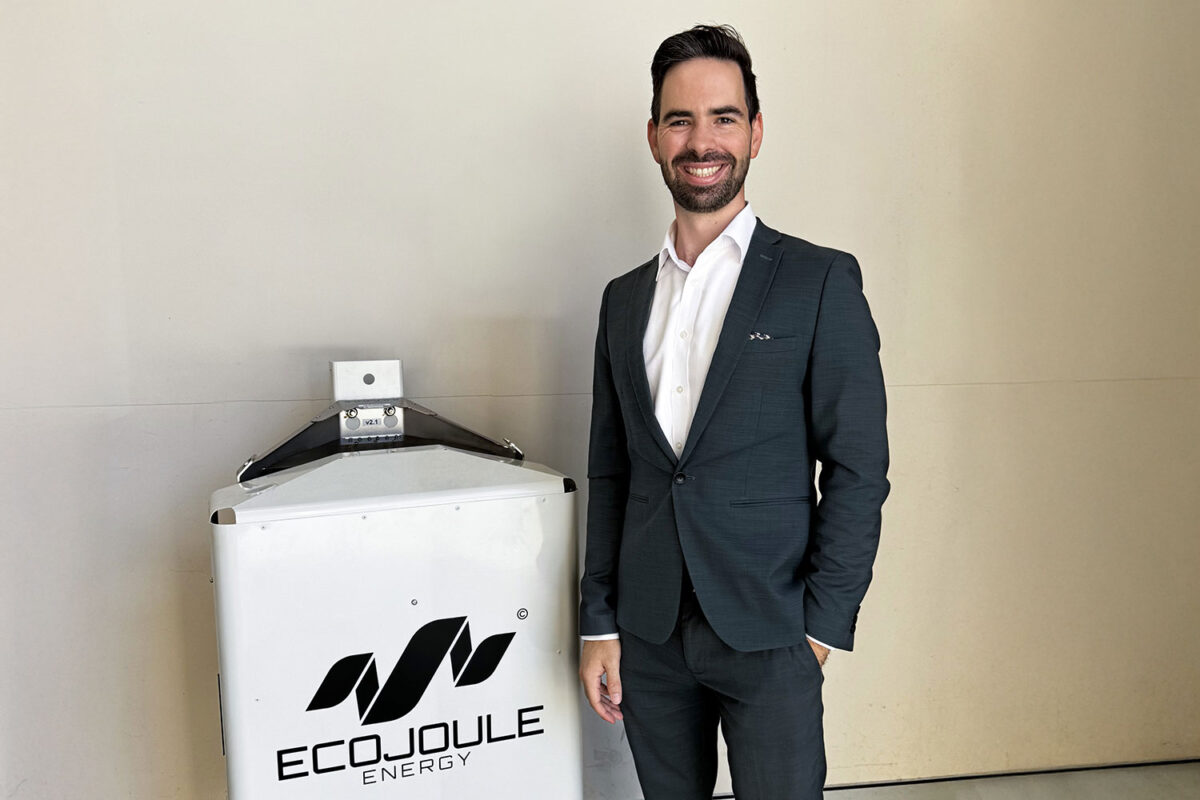
    EcoJoule Appoints NOJA Power’s Martin van der Linde as Chief Commercial Officer

    EcoJoule Energy, a leading Australian energy technology company focused on improving grid stability and enabling renewable integration, has announced the appointment of former NOJA Power executive Martin van der Linde as Chief Commercial Officer (CCO).

    As Chief Commercial Officer, Mr van der Linde will lead EcoJoule’s global commercial strategy, including market expansion, customer engagement and revenue growth.
    Martin joins EcoJoule after more than 13 years in various roles with NOJA Power, most recently as General Manager Marketing. He is a seasoned management, marketing and engineering leader with extensive international experience.

    An accomplished communicator, Martin has presented to executives, engineers, conferences and training audiences across 23 countries. He has been published in eight industry magazines on topics related to power systems, utilities and the broader energy sector.

    Martin is a member of Engineers Australia and a member of the Electrical Energy Society of Australia (EESA).

    EcoJoule Founder and CEO Dr Mike Wishart said Mr van der Linde was a widely-respected leader in the energy industry and he would play a crucial role in EcoJoule’s continued growth.

    “Martin brings a rare combination of engineering depth and commercial acumen, which is exactly what EcoJoule needs as we scale,” Dr Wishart said.

    “His ability to apply engineering principles to marketing and commercial strategy will be instrumental in accelerating our growth both in Australia and internationally.”

    Mr van der Linde said he was excited to be joining EcoJoule at such an important time in their history.

    “EcoJoule is at the forefront of solving one of the most critical challenges facing modern electricity networks,” Mr van der Linde said.

    “I’m excited to help scale the company’s commercial operations and bring its innovative technologies to more markets globally.”

    With a growing customer base that includes major network operators such as Endeavour Energy, Essential Energy, Ausgrid and AusNet Services, EcoJoule is playing a key role in enabling a more stable, resilient and renewable-ready electricity grid.

    EcoJoule Energy’s technology platforms include pole-mounted community energy storage units that store the excess solar energy generated by residents for later use, and a voltage regulation device to help integrate more renewables into the grid.

    EcoJoule Appoints Trevor Armstrong as Non-Executive Director

    EcoJoule Energy, a leading Australian energy technology company focused on improving grid stability and enabling renewable integration, has announced the appointment of former senior Ausgrid executive Trevor Armstrong as a Non-Executive Director.

    As Non-Executive Director, Mr Armstrong brings significant board-level experience and strategic oversight, and will support EcoJoule’s governance, growth strategy and engagement with key stakeholders across the energy sector.

    EcoJoule Founder and CEO Dr Mike Wishart said the appointment would strengthen the company’s governance and strategic capability as it continued to scale its operations across Australia and international markets.

    “Trevor brings valuable experience and insight that will support EcoJoule’s continued growth,” Dr Wishart said.

    “As demand increases for technologies that help electricity networks manage the impacts of distributed energy resources like rooftop solar, strong leadership and governance are critical to delivering on our strategy.”

    Trevor has more than 35 years’ of experience in the energy sector. He has held senior executive roles with Energy Australia, Networks NSW and Ausgrid, including interim Chief Executive Officer and Chief Operating Officer.  More recently, Trevor was the Chief Executive of ACEREZ, the Network Operator of the first renewable energy zone in NSW.

    Trevor is currently on the Board of Power and Water in the Northern Territory and a Partnership Representative on ACEREZ. He has served on the Reliability Panel of the Australian Energy Market Commission, and Chair of CIGRE Australia.

    EcoJoule is playing a key role in enabling a more stable, resilient and renewable-ready electricity grid. And works with a growing client base that includes major network operators such as UK Power Networks (UKPN), Endeavour Energy, Western Power, Essential Energy, Ausgrid and AusNet Services,

    EcoJoule Energy’s technology platforms include pole-mounted community energy storage units that store the excess solar energy generated by residents for later use, and a voltage regulation device that helps integrate more renewables into the grid.