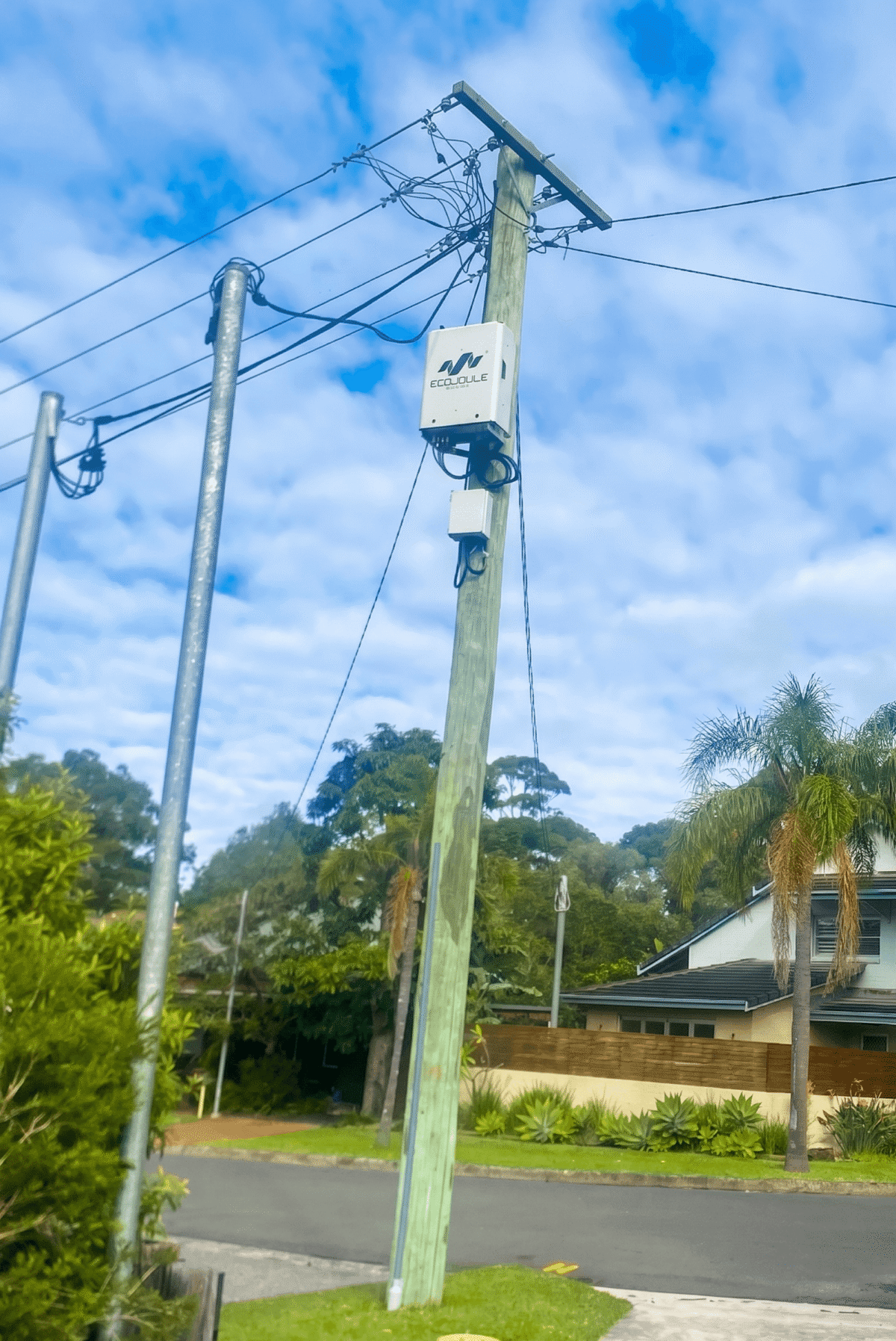
The Per-Phase Compliance Trap

Low-voltage planning has long been able to treat a feeder as a balanced three-phase circuit. For most of the network’s history that was a safe assumption. High penetrations of single-phase distributed generation and single-phase load are ending it, and they do so in a way an aggregate check doesn’t catch.

Voltage compliance is assessed per phase. In Australia, the nominal is 230 V with a range of +10% / −6% (AS60038 and AS61000.300.1), and each phase at the point of supply has to sit inside that range, not the average of the three, each one independently.

Single-phase connections are where this bites. A rooftop inverter or an EV charger connects to one phase, not three. At low penetration the connections diversify across phases and across the day, and the feeder behaves close to balanced. At high penetration that diversity fails. PV exports on the phases it happens to sit on through the middle of the day; EV charging loads other phases through the evening. One phase is pushed toward the upper limit at midday while another is dragged toward the lower limit at the evening peak.

The trap is that the three-phase average can look compliant while an individual phase is in breach. A planner working from aggregate feeder loading, or from a balanced load-flow assumption, sees headroom that isn’t there.

This is not only a high-solar story. Any concentration of single-phase power-electronic load does the same thing from the other direction. EV charging, and increasingly induction cooking, draws hard on whatever phase it happens to be wired to. A network with modest rooftop PV but rising electrification will see the same per-phase divergence, driven by load rather than generation. The mechanism is the connection being single-phase, not whether it imports or exports.

The instinct is to reach for conductor augmentation. Larger conductor lowers impedance, and lower impedance does reduce the magnitude of voltage excursions. That part is real. But it reduces them symmetrically. It does nothing about the asymmetry between phases, and nothing about the time-of-day variation that drives the swing. Conductor is a fixed impedance: it cannot pull a phase down at midday and hold it up at the evening peak. To bring a single over-voltage phase back inside the limit by impedance alone, you would oversize the conductor well beyond the thermal load — paying for capacity you don’t need to address a problem conductor was never the right tool for.

Behind-the-meter batteries are sometimes offered as the answer. For a network planner they are not, because they cannot be centrally controlled, and they are also usually a single phase device, doing which does not fix feeder balance. A customer’s battery cannot be dispatched to hold a phase within limits, and it cannot be counted on for compliance.

What corrects a per-phase, time-variable problem is per-phase, dynamic control. An LV D-STATCOM regulates each phase independently and continuously: absorbing reactive power on the phase running high, supplying it on the phase running low, and rebalancing load across the three phases. It tracks the daily cycle rather than being tuned to a single condition.

There is a second consequence worth naming. Because a feeder is limited by its worst-loaded phase, unbalance leaves real capacity stranded, two phases can sit well under their limit while the third sets the constraint. Rebalancing recovers that capacity and lets a network use conductor it already owns to its actual rating. That is what defers augmentation, rather than simply delaying it.

None of this replaces augmentation, and augmentation does not replace it. They sit on the feeder as two layers doing two jobs. New conductor adds thermal capacity and lowers impedance; it does not balance phases, filter harmonics, regulate voltage through the day, or report the power-quality conditions where it sits. Those functions do not arrive with copper, and they do not stop being needed once copper is installed. The capacity an upgrade unlocks tends to fill with more of the single-phase load and generation that drove the divergence in the first place.

So a STATCOM put in now is not interim spend to be written off when the larger upgrade arrives. It is the control layer that keeps a feeder balanced and compliant before augmentation, through it, and after it. Where the constraint is genuinely thermal and the conductor cannot carry the current, augmentation is the right answer. The STATCOM stays in service, doing the work the new conductor was never going to do. The two are complementary by design.

The per-phase compliance trap is not a future problem. It is already visible on high-penetration feeders that pass an aggregate check and fail a per-phase one. Worth checking which of yours do.
A simplified example: How engineers calculate effective voltage control using shunt connected LV Reactive Power Injection

A common question from distribution engineers assessing a low voltage D-STATCOM is how a 40 kVAr device can support voltage on a feeder that carries far more than 40 kVA. The question almost always traces to one assumption: that the device sits in series with the feeder and must carry the full load current, the way a line voltage regulator does.

A shunt-connected D-STATCOM does not work that way. It connects in parallel, carries only its own reactive current, and supports voltage through the reactance between its connection point and the source. This note sets out the mechanism and works a representative example.

A series voltage regulator is installed in line with the feeder. All feeder current passes through it, so it must be rated for the full through-current, often several hundred amps. Measured against that benchmark, 40 kVAr looks too small to matter.

A shunt D-STATCOM connects across the feeder at a single point. Feeder current does not pass through it. The device carries only the current corresponding to its own rating:

I = Q / (√3 × V) = 40,000 / (√3 × 400) ≈ 58 A
where Q = 40 kVAr, V = 400 V phase to phase

That 58 A is independent of feeder loading. The device is sized to its own reactive current, not to the feeder it supports.

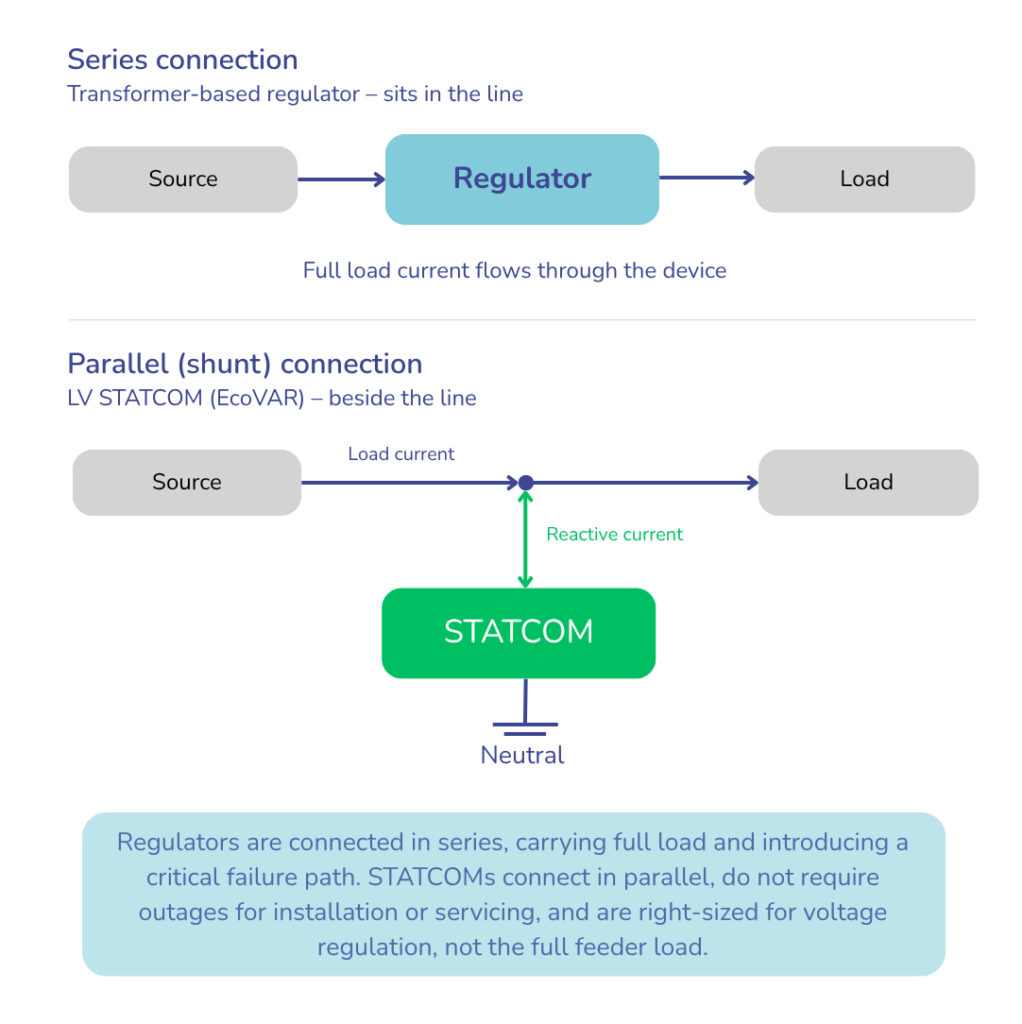
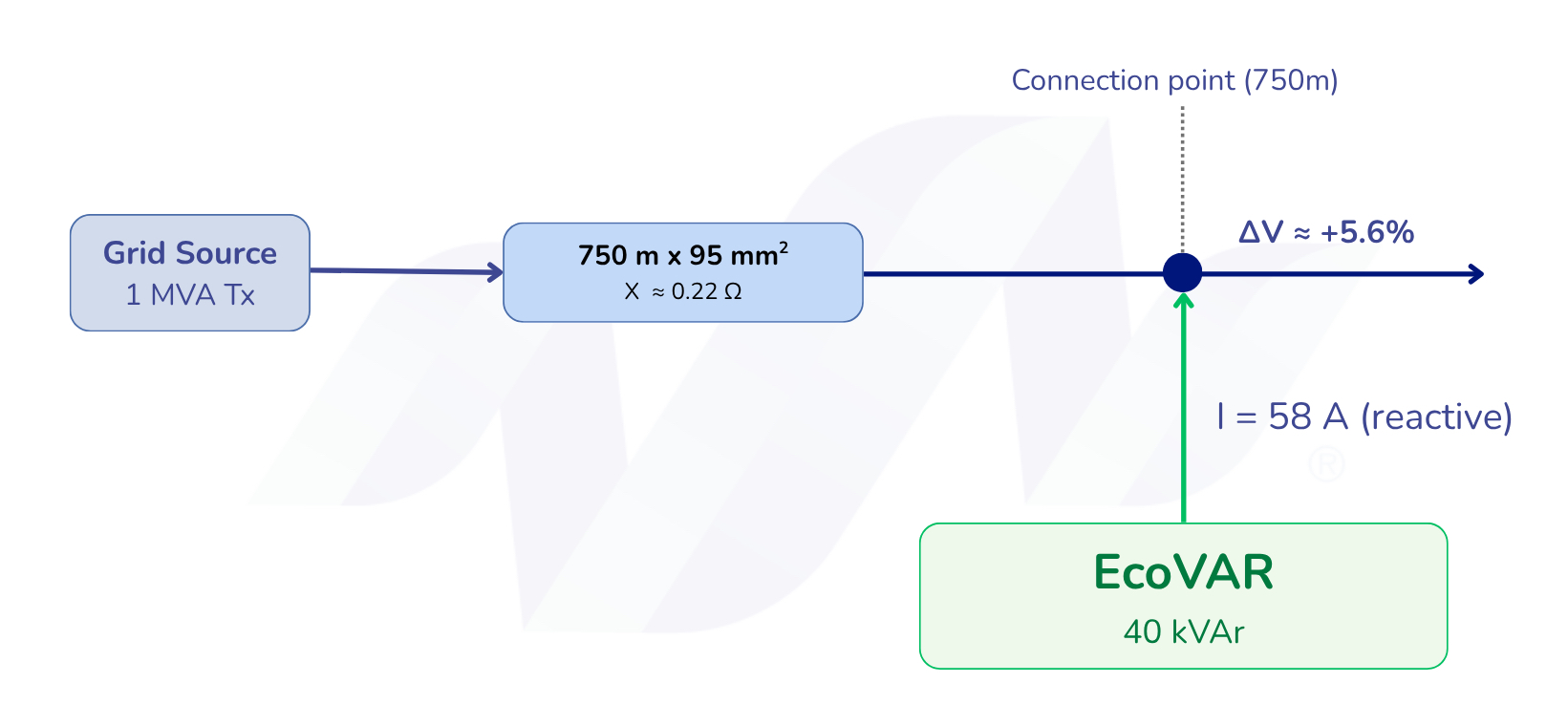
Figure 1. The EcoVAR connects in parallel at the feeder. Feeder load current flows along the line, not through the device. The voltage rise is set by the reactance between the connection point and the source

The network behind any connection point can be represented as a source with a series impedance, R + jX, back to it. Current flowing through that impedance produces a voltage difference. The familiar low voltage drop relationship is:

ΔV ≈ (P·R + Q·X) / V

A shunt D-STATCOM supplies reactive power locally, so that reactive power no longer has to be imported through the upstream reactance X. Removing Q from the upstream path removes the Q·X voltage drop it was causing, and the local voltage rises. For a reactive-only device the support reduces to:

ΔV ≈ Q·X / V

Consider a 1 MVA distribution transformer feeding a 1 km low voltage feeder on 95 mm² overhead conductor, with the D-STATCOM connected 750 m along the feeder. Representative values:

Transformer reactanceXtx ≈ 0.008 Ω
Line reactance to the connection point (0.29 Ω/km × 0.75 km)≈ 0.218 Ω
Total upstream reactanceX ≈ 0.225 Ω

Applying the relationship:

ΔV ≈ Q·X / V = 40,000 × 0.225 / 400 ≈ 22.5 V ≈ 5.6%

The same result follows from the device current and the upstream reactance, which is worth showing because the two routes are the same physics:

ΔVLL ≈ √3 × I × X = √3 × 58 × 0.225 ≈ 22.5 V

On this feeder, a 40 kVAr device applies about 5.6% voltage correction at its connection point.

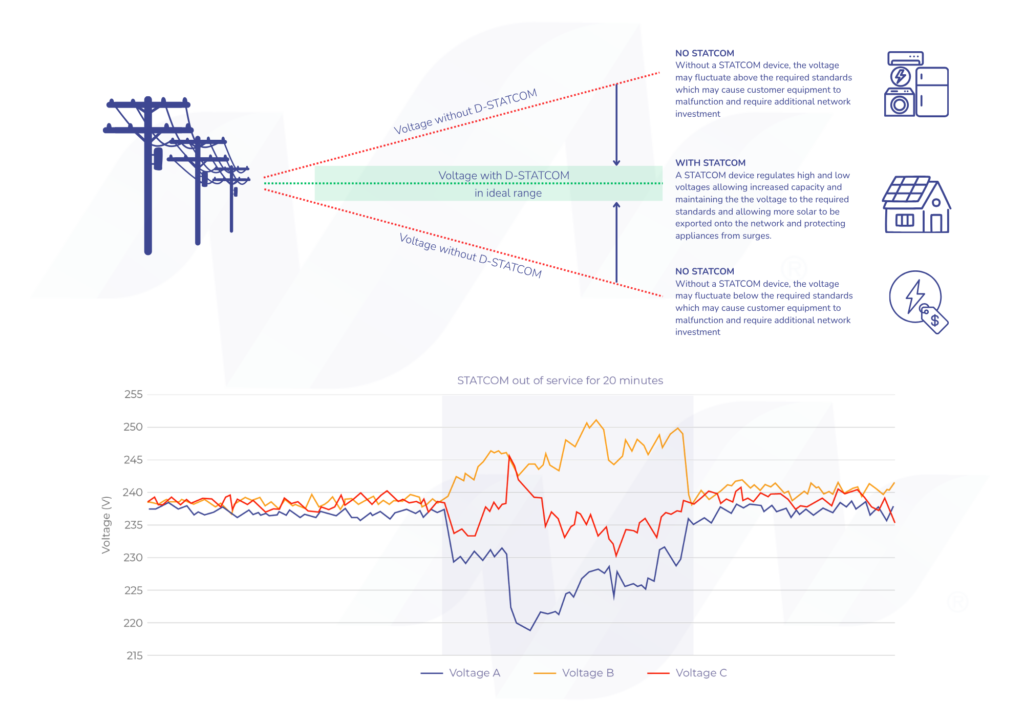
It’s important to remember that the STATCOM can both source and sink VARs, so it can move the voltage in either direction, either up or down 22.5V in this simplified case. This allows it to respond to voltage rise from solar, or voltage drop from load, in real time.

The feeder in the example is 1 km long, but the device sits at 750 m. The final 250 m plays no part in the calculation, because the device’s reactive current flows back to the source through the upstream reactance only. Voltage authority is set by the impedance between the device and the source, not by the total feeder length. This is why siting matters: the device belongs where the upstream reactance, and the voltage problem, are greatest. It is also the clearest distinction from a series device, whose effect depends on what lies downstream of it.

The Q·X / V relationship depends on the feeder having meaningful reactance. Overhead open-wire conductor, with an X/R ratio near 1, meets that condition. On low-reactance cable the same kVAr produces little voltage movement, and a D-STATCOM earns its place through phase balancing rather than bulk reactive support.

It is also worth separating the correction the device applies from the total feeder voltage drop. On a feeder with X/R near 1, the real-power drop (P·R) from load current is comparable to the reactive drop, and a reactive device does not act on it. The 5.6% figure is the correction available at the connection point, not the elimination of the feeder’s full drop under load.

In practice. A shunt D-STATCOM provides voltage correction at the point where it is needed, sized to its own reactive current rather than to feeder loading. The EcoVAR adds two capabilities relevant to low voltage feeders: independent phase balancing, which addresses the per-phase voltage problem that symmetric reactive injection cannot, and installation without a feeder outage. On a weak overhead feeder these allow voltage to be corrected at the connection point in place of, or ahead of, conductor augmentation.

STATCOMs Overcome the Limits of Traditional Voltage Regulators on Low-Voltage Networks

As rooftop solar, batteries and electric vehicles push low-voltage networks beyond the conditions they were designed for, distribution businesses are re-examining how they manage voltage.

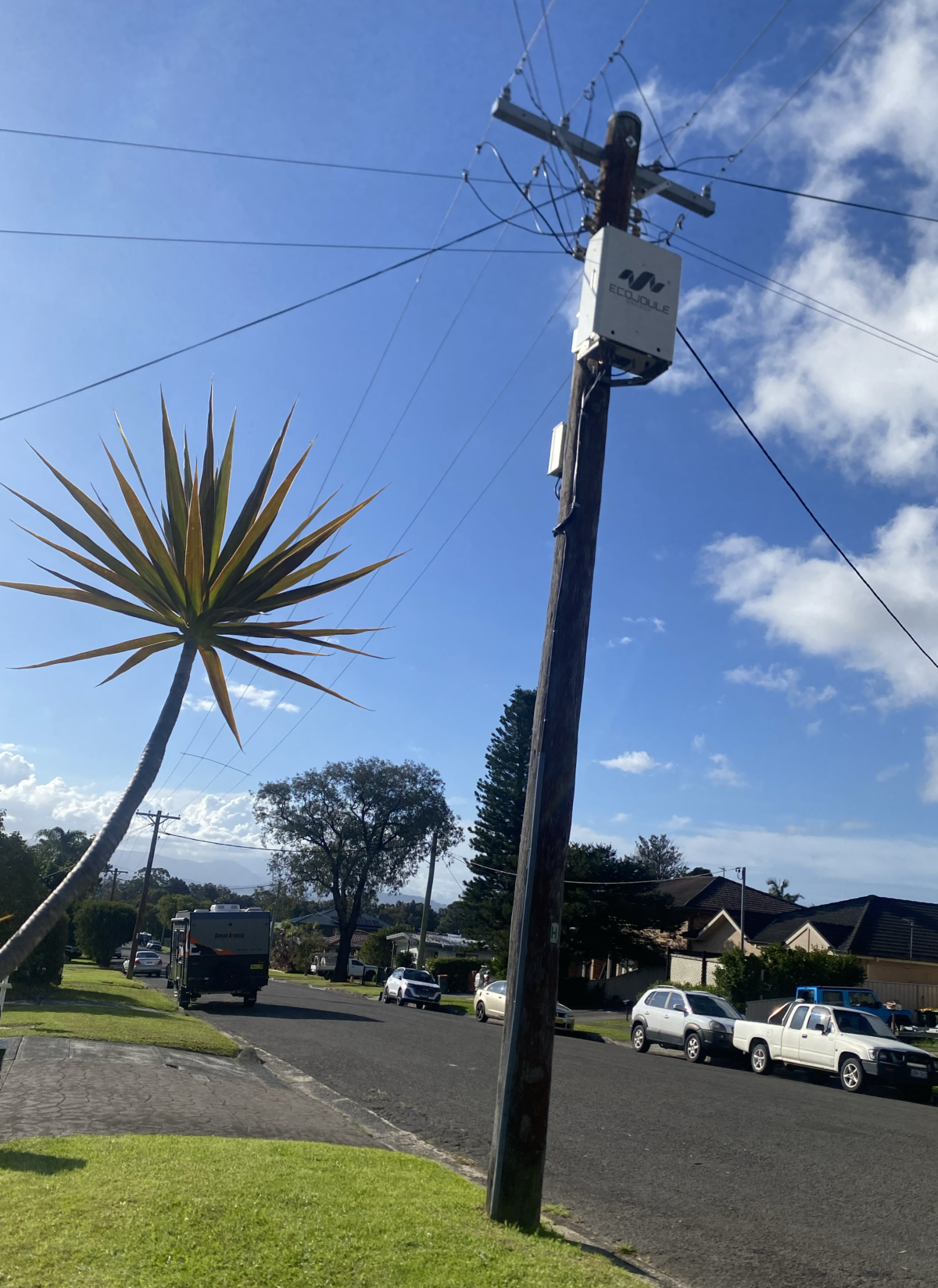
These distribution businesses are increasingly turning to low-voltage distribution STATCOMs (D-STATCOMs), like EcoJoule Energy’s EcoVAR, to address constraints that are inherent to traditional series voltage regulators, and do so without taking feeders out of service to install.

Traditional voltage regulators are connected in series with the feeder. The whole feeder current passes through the device, which sets its rating, size and the work required to install it. A STATCOM takes a different approach: it connects in parallel. The feeder current flows past the unit, and only the corrective current flows through it.

How a STATCOM differs from a traditional voltage regulator

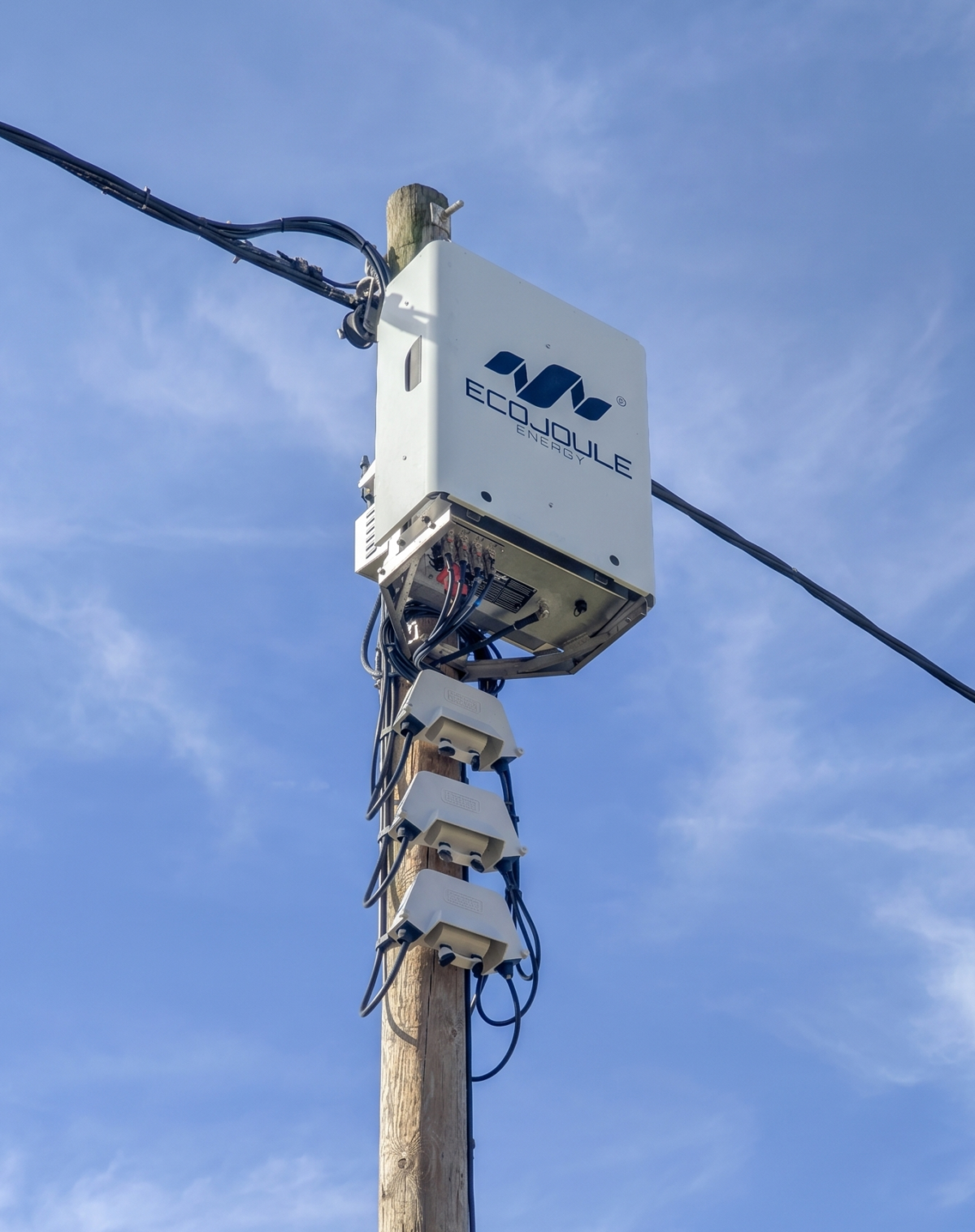
  • Parallel connection, not series. A series regulator carries the full feeder current. The EcoVAR connects in parallel, so feeder current flows past it and only the corrective current flows through the unit.
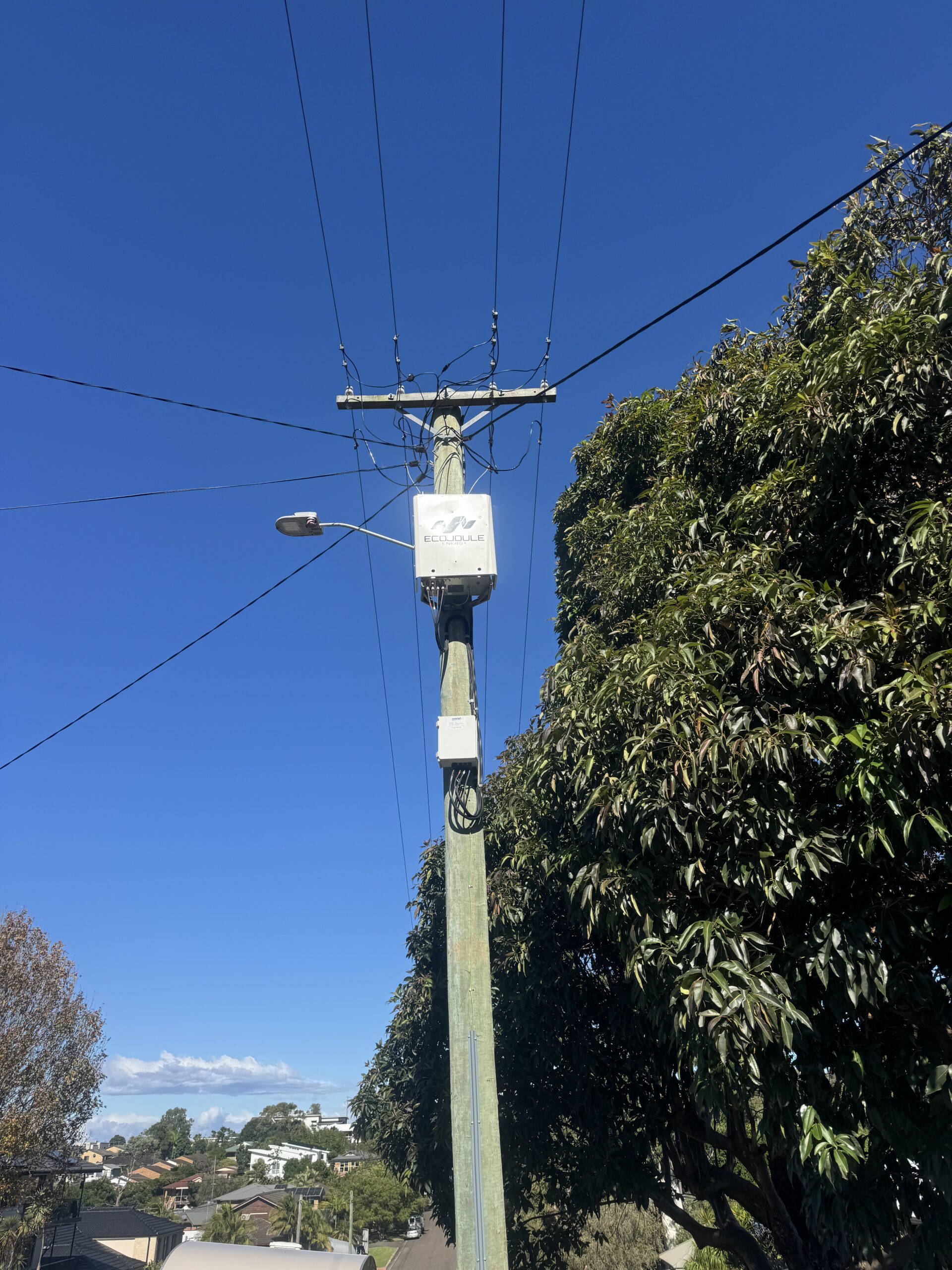
  • Rated below feeder current, so smaller. Because it carries only the corrective current, a STATCOM can be rated for a fraction of the feeder current it supports. The result is a compact unit that suits an existing pole or enclosure.
  • Installed without an outage. The parallel connection means the EcoVAR can be added to a live feeder and commissioned in hours, without the planned supply interruption a series device requires.
  • Sub-cycle response. Power-electronic switching corrects voltage within a single cycle — a response far faster than the step changes of mechanical tap-changing regulators.
  • Corrects imbalance between phases. A regulator that moves all three phases together cannot fix a feeder where some phases sit above the target voltage and others below — stepping the high phase down drags the low phases further down. The EcoVAR regulates each phase independently and shifts load between phases, bringing all three within limits at once and releasing feeder capacity for more solar.
  • Holds its reference under two-way power flow. Traditional regulators reference the “line side voltage” for regulation. When rooftop solar exports and power flows back up the feeder, that reference is lost and the regulator can step the wrong way. A STATCOM sits in parallel, measures the local voltage directly, and injects or absorbs reactive power to hold it, so two-way flow does not disorient it.
  • Active harmonic filtering too. Alongside voltage support and phase balancing, the EcoVAR filters harmonics, helping maintain power quality as more inverters and electronic loads connect.

In service across six markets

EcoVAR units are in service addressing voltage problems in the United Kingdom, Belgium, Lithuania, Australia, Malaysia and New Zealand.

In the United Kingdom, UK Power Networks is operating the EcoVAR on its network through an innovation project, with pole-mounted units installed in Kent. Details are published by UK Power Networks at ukpowernetworks.co.uk.

About EcoJoule Energy

EcoJoule Energy is an Australian energy technology company, established in 2014 and based in Brisbane. It develops technologies for the future grid, including low-voltage distribution STATCOMs (EcoVAR) and battery energy storage systems. EcoJoule’s technology relieves grid congestion and allows solar generation to reach more customers, maximising the use of existing poles and wires so the benefits of the energy transition can flow to all users of the distribution grid.

How a Low Voltage Distribution STATCOM Works

A distribution STATCOM (D-STATCOM) is a power-electronic device connected to the low-voltage (LV) network to regulate voltage. It does the job of a voltage regulator, but instead of switching taps or capacitor steps, it exchanges reactive power with the grid continuously and adjusts within a fraction of a mains cycle. That speed, and the resolution it brings, is what separates it from conventional correction equipment.

An Advanced Voltage Regulator

At its core, a D-STATCOM is a voltage-source converter. By controlling the magnitude and phase angle of its output voltage relative to the grid, it either sources reactive power to raise local voltage, or sinks reactive power to lower it. There are no discrete steps. The output is variable across its full range, so the converter can hold voltage at a target rather than bracketing it between tap positions.

Advanced LV units control each phase independently. This matters on the LV network, where single-phase rooftop solar, EV charging and uneven load routinely pull the three phases apart. A per-phase controller corrects each phase to its own target instead of applying one average correction across all three.

Sub-Cycle Response and Active Harmonic Filtering

A D-STATCOM samples and adjusts its output many times within a single 50 Hz cycle. This sub-cycle response lets it track fast voltage variations that step-based equipment cannot follow.

The same capability allows it to act as an active harmonic filter. Non-linear loads inject harmonic currents that distort the voltage waveform. Because the converter can shape its output within the cycle, it synthesises a waveform that drives a compensating current — equal in magnitude and opposite in phase to the harmonic content already on the network — so the two cancel at the point of connection. The result is a cleaner voltage waveform without the tuned, passive filter banks that conventional approaches rely on.

Connected in Parallel, Not Series

A D-STATCOM is connected in shunt (parallel) with the network, not in series with the load. It injects current at its point of connection rather than carrying the line current through itself.

This is the reason a relatively low-power STATCOM can have a large effect on voltage. On an electrically weak network — long feeders, small conductors, high source impedance — a modest injection produces a meaningful voltage change. A small shunt device therefore moves voltage far more than its rating alone would suggest, precisely where the network is least able to support itself.

FOR THE TECHNICALLY MINDED

The voltage change at a point depends on both the resistance (R) and reactance (X) of the network. The LV grid R/X ratio is higher than medium voltage, increasing active power (ΔP) voltage leverage— which sets up the next capability.


Active Power Transfer: The EcoVAR Difference  

The most advanced LV STATCOMs do more than exchange reactive power. The EcoVAR moves active power between phases through its common neutral, drawing real power from a heavily loaded or high-voltage phase and delivering it to a lightly loaded or low-voltage phase. Because active power has strong voltage leverage on LV feeders, balancing the real power flow across phases is often the most effective lever available — and it tackles voltage imbalance, the dominant LV problem as single-phase solar and EV connections grow. The EcoVAR therefore provides active power support alongside reactive power support, rather than being limited to compensation the network is poorly placed to use. It redistributes real power across the three phases through the neutral; it is not a generation source.


Why LV STATCOMs Are Gaining Ground

High renewable penetration is changing where instability shows up on the grid. Voltage rise from clustered rooftop solar, imbalance from single-phase connections, and harmonics from inverters now originate inside the LV network, close to the customer. Two factors are driving adoption:

  1. Cost. Compared with conductor upgrades, additional transformers, or large centralised compensation, a distributed LV STATCOM is a lower-cost way to manage these conditions — and the EcoVAR installs with no outage required.
  2. Location. A shunt LV device applies regulation and reactive power at the source of the problem, on the feeder where the issue arises — rather than generating reactive power upstream and pushing it down the line alongside real power, loading the very conductors it is meant to relieve.

By correcting voltage, balancing phases and filtering harmonics locally, the LV STATCOM frees up capacity on existing poles and wires. That lets more solar generation reach more customers without the cost and disruption of rebuilding the network.